


























Delivered live at the hour the Hanoi People’s Court opened the trial
8:30 AM, 3 August 2026
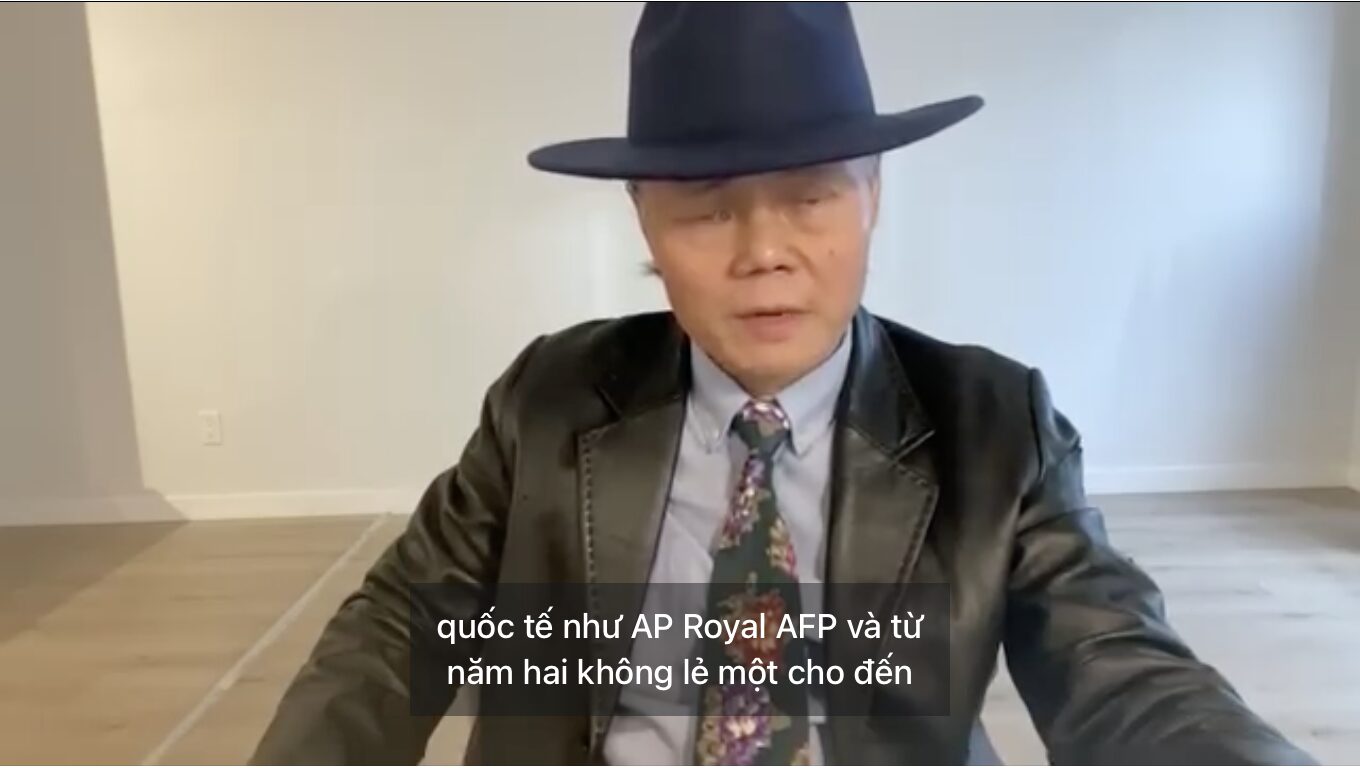
At this hour, in Hanoi, the People’s Court is opening my trial. I am not in that courtroom. I am here.
I am Đoàn Bảo Châu, a journalist and photojournalist. I have been indicted by the Hanoi People’s Procuracy under Article 117(1)(b) of the Penal Code, and I am being tried, as I speak, in my absence.
The entire body of evidence against me consists of six videos: five live conversations broadcast on Facebook, and one panel discussion produced by BBC Vietnamese. The expert assessment issued by the Hanoi Department of Information and Communications assigns to them two categories of content: “propaganda of psychological-warfare rhetoric, fabrications causing panic among the people,” and “distortion, defamation, and injury to the reputation of organisations and to the honour and dignity of individuals.”
Those six videos still exist, intact. The Forensic Science Institute of the Ministry of Public Security examined them and certified that they bear no trace of cutting, splicing or editing. That means every sentence in them can be checked word for word. This statement does precisely that.
I. WHAT ARTICLE 117 REQUIRES
Article 117 is made out only when two elements are both present: the information must be fabricated or distorted, and its maker must have the purpose of opposing the State.
Without the first element there is no offence, whatever the motive. Without the second there is no offence either, however sharp the content — because sharp criticism is a constitutional right under Article 25 of the 2013 Constitution and Article 19 of the International Covenant on Civil and Political Rights, which Vietnam joined in 1982.
As to the second element, let me state my true purpose plainly, at the very outset of this defence. I was simply exercising freedom of expression: the right of a reporter to seek out the truth, and the right of a citizen to offer constructive views for a better society. That was my entire purpose in these six videos. The Vietnamese authorities have deliberately fitted me with a label, and cast me as a criminal.
That statement is not a mere assertion. Everything that follows is the evidence for it — in my own voice, within the very recordings the Ministry of Public Security has certified as intact.
The prosecution must therefore identify: which sentence is fabricated, what the corresponding truth is, and what document proves it. Across two years of investigation, two expert assessments and one indictment, not a single sentence has ever been identified.
II. WHAT THE SIX VIDEOS ACTUALLY CONTAIN
VIDEO 1 — PRISON CAMP NO. 6, THANH CHƯƠNG, NGHỆ AN (JUNE 2019)
I open the broadcast with these words: “We are sheltering in air-conditioned rooms, or going out to escape this ferocious heat. Meanwhile those prisoners have been stripped of a very basic right — the right to use an electric fan.” And I go on: “Vietnam has signed the United Nations convention against torture and inhuman treatment of prisoners.”
That is the legal basis I invoke in the opening minute: a convention the Vietnamese State itself signed voluntarily.
Mr. Duy Tùng, son of the schoolteacher Đào Quang Thực, asked whether removing the fans in heat above 42 degrees Celsius could be reasonable, answers: “No, sir. Because that is deeply cruel.”
Mrs. Nguyễn Kim Thanh describes her prison visit of 20 June 2019: her husband Trương Minh Đức dropped onto the chair, his eyes glazed, his head sinking; he told her he had not eaten for ten days. She recounts his words: “I don’t think you and I will ever have the chance to be together again.” Officers slammed on the table and cut in each time the couple mentioned the fans or named another political prisoner, then terminated the visit halfway through the allotted time.
Mrs. Bùi Thị Rề says her husband, Nguyễn Văn Túc, was “terribly thin, stooped, unable to walk,” and had gone sixteen days without food; fifteen officers sat in the visiting room; the intercom was cut off at the fortieth minute.
Mr. Nguyễn Văn Hải, known as Điếu Cày, who was himself held in that same Camp No. 6 from April 2013 to October 2014 and who conducted a 35-day hunger strike there, sets out the legal specifics: Article 38 of the Law on Execution of Criminal Judgments caps disciplinary confinement of a prisoner at ten days, whereas Circular 37 of the Ministry of Public Security — a sub-legal instrument — permits separate confinement of non-confessing prisoners for three to six months. He also cites the rule obliging a prison governor to forward a prisoner’s complaint to the Procuracy within twenty-four hours.
At the end of the video I call for three things: share the information; send petitions to Prison Camp No. 6, the Nghệ An Procuracy and the Ministry of Public Security; support the families. By then, eight organisations and nearly two hundred individuals had signed petitions.
And here is what happened next. On 10 December 2019, less than six months after the broadcast, schoolteacher Đào Quang Thực died while serving his sentence at Prison Camp No. 6. His family asked for his body. The camp refused. He was buried inside the prison grounds.
I ask the prosecution: which sentence in this video is fabricated?
VIDEO 2 — THREE LAWYERS ON THE ĐỒNG TÂM APPEAL (MARCH 2021)
The three lawyers Trịnh Vĩnh Phúc, Đặng Đình Mạnh and Ngô Anh Tuấn set out exactly what they had already stated in open court: no witness, no eyewitness, no interested party and no forensic expert was summoned; no reconstruction of the scene was conducted, in a case with four deaths; the fourteen lawyers’ petition of more than thirty pages went unanswered; the appeal lasted two days, with roughly one hour of deliberation, and upheld two death sentences.
Lawyer Đặng Đình Mạnh identifies three possible causes of the deaths of the three police officers in the skylight shaft that the case file never resolved: gasoline, the total quantity of which, on the testimony in the file, was under one litre; CO2 from two fire extinguishers discharged into the shaft — and the autopsy record notes the presence of CO2; and the equipment carried on the bodies of the two riot police themselves. He also points to a physical contradiction: a pole with a blade attached, one to two metres long, could not reach the bottom of a shaft roughly four metres deep.
Lawyer Ngô Anh Tuấn cites the testimony of the participating officers themselves, in which they record their own units as “strike team one, strike team two, strike team three” — and raises the question: a plan to safeguard public order does not have strike teams. He states plainly that this is a doubt, and that the doubt ends only when Plan 419A is disclosed.
The lawyers also raise: the wounds of Mr. Bùi Viết Hiểu and Mrs. Bùi Thị Nối and the damage to civilians’ property were never examined; the cause of Mr. Lê Đình Kình’s death was never established; and there was a conflict of interest in the Hanoi police both taking part in the operation and investigating that same operation.
And here is the passage the prosecution needs to read closely, because it sits inside the very exhibit they are using against me. Near the end, I say, word for word: “In the Đồng Tâm affair, the thing that pains me most is those few farmers who went online to boast that they had weapons. In a country like ours, the people’s struggle must never involve weapons, must never involve waving around some pitiful weapon to threaten or show off to anyone. Because that is utterly foolish. Our struggle for justice must never touch violence. And anyone who opens his mouth to say that violence must be answered with violence — those are unscrupulous people, pushing citizens into the reach of the criminal law.”
A man indicted for propaganda against the State — in the very exhibit, condemning citizens taking up weapons and calling those who incite violence unscrupulous. The element of “purpose of opposing the State” collapses right there, in the voice that the forensic examination has certified as mine.
What the lawyers and I called for was a cassation review — a procedure contained in the Criminal Procedure Code itself — citing wrongful convictions the State has itself acknowledged: Nguyễn Thanh Chấn and Huỳnh Văn Nén.
VIDEO 3 — HUMAN RIGHTS AND THE ICCPR DIALOGUE IN GENEVA (MARCH 2019)
The guests were four people who had submitted independent reports to the United Nations: Mrs. Đinh Ngọc Tuyết, Mrs. Nguyễn Mỹ Hạnh, Mr. Vũ Quốc Ngữ and Mr. Đoàn Huy Chương.
The figure of 216 unexplained deaths in custody over three years, and 12 deaths in police stations in 2018 — I state clearly in the video that these come from the domestic official press, and that anyone can look them up. The UN Human Rights Committee likewise cited these figures, drawn from the Ministry of Public Security’s own report to a body of the National Assembly.
Mr. Đoàn Huy Chương, who passed through eight prisons over eight and a half years, describes the conditions of detention and says, word for word: “Everything I have said from the beginning until now, I say on my honour — it is entirely the truth, and I have not added one small thing against them.”
And here is what I myself say in that video: “We must also acknowledge that this year they did take part, and that is progress on their side, and we ought to recognise it. Whatever we say, there must be fairness; we must not be extreme.”
And: “We act in good faith, so that awareness of human rights — among the people and among the authorities alike — is raised. That is what will move Vietnam forward.” I also say plainly: “I am not an anti-communist.”
I ask: would a man whose purpose is to oppose the State praise the State’s progress, call for fairness, and declare his own good faith — inside the very material said to constitute the offence?
VIDEO 4 — ASSOCIATE PROFESSOR NGUYỄN HOÀNG ÁNH ON PHẠM ĐOAN TRANG
Professor Ánh’s assessment of the book Popular Politics: “I did not find anything in that book that could be called a call to violence or an incitement to overthrow anything.”
She analyses the opinion of the UN Working Group on Arbitrary Detention and identifies its clearest point: the actual date of arrest differs from the date on the arrest warrant.
She invokes the example of Vietnam’s own communist leaders: President Hồ Chí Minh in the years after 1945 gathered around him even those who disagreed with him; Prime Minister Võ Văn Kiệt kept and made room for the intellectuals of the former regime. She says she hopes today’s leaders will relearn that lesson.
And in that video I say: “I hope the Vietnamese government will gradually change. It cannot be that every time someone speaks up in criticism of the authorities, they are automatically labelled a reactionary, a hostile force. Let me say plainly: in this country I have never met anyone with any intention of overthrowing the government.”
I also say something in that video that reads bitterly today: “For a country to develop, trials described as public must be open to public observation — they should even be filmed and broadcast, so that people can learn about the law, understand the law, and avoid breaking it.”
VIDEO 5 — MRS. ĐẶNG THỊ HUỆ AND THE BẮC THĂNG LONG TOLL STATION
My first question, word for word: “How can you be sure that what happened was not an accident but an attack?”
Mrs. Huệ answers: “I don’t claim it. In my own heart I am certain, but before the public I leave that conclusion to everyone else. Because I have the right to suspect.”
The material about the toll booth — collecting in Hanoi to repay the Vĩnh Yên bypass in Vĩnh Phúc province twenty-eight kilometres away; the previous permit expired in 2007; no station name board, no project information; the investor being BOT Vietracimex 8 Joint Stock Company — had all been raised on the floor of the National Assembly and dissected in the state press; three successive Chairmen of the Hanoi People’s Committee had issued documents calling for the booth to be shut down.
My appeal in that video, word for word: “Wherever you go, if you see a fee being charged that isn’t right, you must ask. And if they cannot explain it, do not simply accept and pay.” The interview was conducted online. It produced no gathering of any kind.
VIDEO 6 — BBC VIETNAMESE PANEL ON THE FLOODS IN CENTRAL VIETNAM
This programme was produced by BBC journalists, recorded on 20 October 2016 and published on the BBC’s own channel. I was one of four invited guests, alongside Ms. Giang Phạm of the Flood-Resistant Housing project, the journalist Phạm Tường Vân, and the singer Ánh Tuyết.
Three points I made: one or two hours’ warning before a dam release is unacceptable; after forty-one years, life in Central Vietnam has not improved, because every year the floods sweep everything away; and relief work remains amateur and uncoordinated — I said I was astonished that the army was not deployed to rescue people in cut-off areas.
And my concluding words in that programme, verbatim: “The party that must improve this situation can only be the Vietnamese government. Only the government can recognise how serious the problem is, change course, and prepare for next year’s flood season.”
I placed my trust in the government as the only body able to solve the problem. Those are the words of a citizen offering advice, not of a man seeking to tear something down.
III. MEASURED AGAINST EACH PHRASE OF THE CHARGE
“Fabrications.” The hunger strike at Camp No. 6 was real, with named individuals and a death confirmed six months later. The Đồng Tâm appeal was real, held in open court. The figure of 216 comes from the state press. The opinion of the Working Group on Arbitrary Detention is an official UN document. The irregularities of the Bắc Thăng Long toll booth were raised in the National Assembly. The 2016 floods were witnessed by the whole country. Not one fact originated with me.
“Causing panic among the people.” The six videos were public for three to nine years, viewed hundreds of thousands of times, and produced not one incident, not one complaint, not one administrative penalty. The file was opened only in May 2024. Conduct that produces no consequence for eight years cannot be conduct that causes panic.
“Psychological-warfare rhetoric.” Psychological warfare is an organised, directed activity aimed at breaking an adversary’s will. These six videos are conversations I conducted alone, with a telephone, with no organisation, no funding and no direction. Within those very videos I condemn violence, acknowledge the State’s progress, and place the duty of improvement in the government’s hands.
“Distortion, defamation, and injury to the reputation of organisations and to the honour and dignity of individuals.” The expert assessment names no organisation and no individual. In all these years, no organisation and no individual has filed a complaint. Defamation is an offence that requires a victim. Here, no victim exists.
IV. THE PROSECUTION FILE CONTRADICTS ITSELF
First, the Forensic Science Institute of the Ministry of Public Security concluded that the six videos contain no cuts and no edits. The prosecution’s own forensic science certifies that these interviews are intact and truthful.
Second, I am charged with “making, storing, disseminating” — yet the emergency search of my home, according to the case file itself, seized no object and no document related to the case.
Third, the finding on content comes from no independent expert body, but from the Hanoi Department of Information and Communications — an administrative organ within the same apparatus as the prosecution, holding no scientific competence to adjudicate the truth of an event.
Fourth, the indictment describes the people I interviewed as “certain individuals of unclear identity.” They are three lawyers listed in the bar directory, a university associate professor, family members of prisoners whose files sit within the prison system itself, and a woman who holds a sentence issued by a Vietnamese court. If the speakers were never identified, their words cannot be found fabricated. And if they were identified, they had to be summoned as witnesses — which was never done.
V. ON THE CALL TO “SURRENDER”
The court has called on me to surrender in order to enjoy the leniency of the law and to exercise the right of self-defence. Let me be clear: to surrender — đầu thú — is defined in the Criminal Procedure Code itself as the act of an offender. To use that word before trial is already to breach the presumption of innocence guaranteed by Article 13 of the Criminal Procedure Code and Article 31 of the Constitution. As for the right of self-defence, it is a constitutional right granted freely to every citizen — not a reward to be purchased by delivering oneself into a detention centre.
VI. THREE REQUESTS
I ask the trial panel, sitting at this very hour, to do three things, all within the court’s power.
One: play the six videos, in full, in the public courtroom.
Two: identify each sentence held to be fabricated, together with the corresponding truth and the document proving it; and name the organisation and the individual said to have been injured.
Three: summon as witnesses the people who spoke in the six videos.
If those three things are done and the prosecution proves even one fabricated sentence, I will accept the verdict.
VII. WHY I KNOW THOSE THREE REQUESTS WILL NOT BE GRANTED
I know they will not be granted. Not because they are difficult — they are simple, and any court in the world could carry them out in a single morning. But because the entire logic of the case against me holds no logic at all, and it does not need to, since the judicial system in Vietnam does not truly serve justice: it is an instrument in the service of authoritarian rule.
This is not conjecture. The record of many years shows it: dispossessed citizens have cried out for justice, petitioning one level of authority after another, some spending a decade of their lives clutching a complaint — and no one resolves anything for them. Those people appear in these six videos: people whose land was taken, a woman whose arm was broken for protesting a toll booth placed where it did not belong, the families of prisoners. Not one of them found justice in a Vietnamese court. Only when their voices carried beyond the borders did anyone begin to care — and that concern was never for them, but for silencing the voice.
Under a government genuinely of the people and for the people, I would be thanked for my contribution. These six videos point to the places where the system is failing: a prison that stripped its inmates of electric fans in lethal heat; an appeal disposing of two death sentences in two days; deaths in custody that the state press itself has counted; a toll booth that three successive mayors of the capital asked to have removed and that still stands; floods for which people were given one or two hours’ warning. Pointing at the leak is the work of a man who wants to keep the house standing. I should have been thanked. Instead, I am prosecuted.
I therefore reject this verdict in its entirety. Not the length of the sentence — the whole of it. And let me state plainly my purpose in standing here today: to expose the rot of a judicial system in particular, and of an authoritarian apparatus that does not place the interests of its own people first.
A court confident in its own reasoning would play those six videos in the middle of the courtroom, because doing so could only help the prosecution. A court that dares not play them has already answered my question — and that answer says nothing about me. It speaks about the court.
VIII. CONCLUSION
I affirm that I am innocent.
In these six videos I did one thing: I asked questions and let those who answered speak. I called for peaceful conduct, for compliance with the law, for petitions to the proper authorities, for cassation review through proper procedure — and I condemned the use of violence by name. I acknowledged the State’s progress and placed the duty of improvement in the government’s hands. All of it sits in recordings that the Ministry of Public Security itself has certified as intact.
If asking questions is a crime, then journalism is a criminal profession.
If pity for prisoners stripped of their fans in forty-two-degree heat is opposition to the State, then compassion itself is opposition to the State.
At this moment they are trying me in my absence. But the truth is present — in six videos still intact online, in the eyes of those now watching, in a conscience no one can imprison. The truth does not need to be defended with handcuffs. The truth only needs to be seen.
I do not ask for leniency. Leniency is for the guilty. I demand justice.
Đoàn Bảo Châu