


































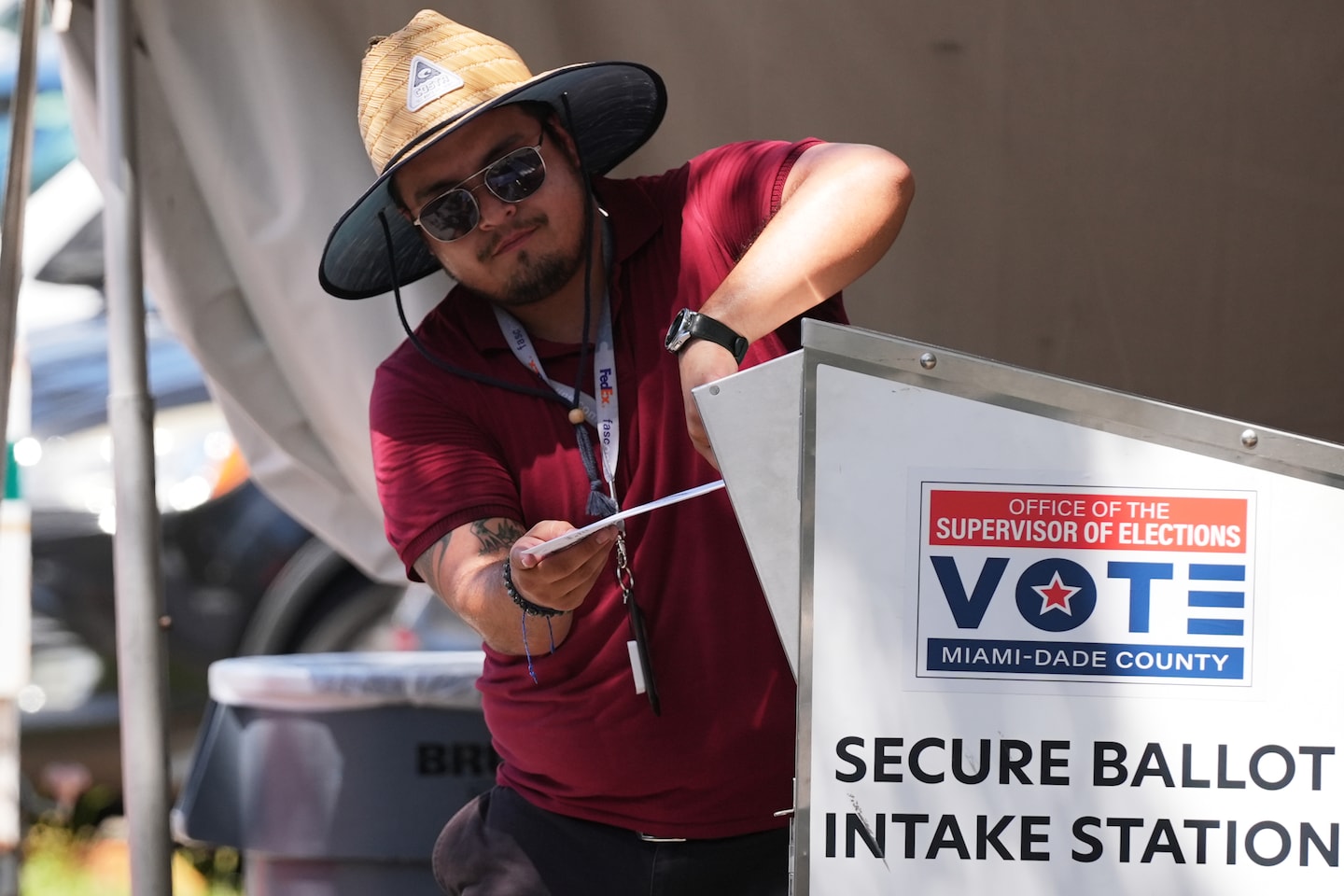
With November midterms approaching, two swing states are sending ballots, and other states plan to send theirs soon.
September 6, 2026 at 11:
Nearly a third of voters used mail ballots in 2024, and last-minute changes to how they are handled could lead to undelivered ballots and uncounted votes.
Trump has long argued that mail ballots are prone to fraud, though evidence over many elections and independent investigations suggests that mail-in balloting is secure and that any fraud is exceedingly rare. Trump regularly votes by mail, including in last month’s primaries in Florida.
A lower-court judge has blocked Trump’s plans for now in a legal fight that has made its way to the Supreme Court once and could soon be before the justices again. On Sunday, the Trump administration asked the Supreme Court to pause the injunction, saying its reasoning is “baseless” and erroneously blocks the president’s goals.
The Supreme Court could still upend mail ballot rules, but the president and the U.S. Postal Service are running out of options that don’t involve significant upheaval because tens of thousands of voters will be getting ballots in their mailboxes in the coming days.
New rules are ‘effectively impossible’
Wisconsin’s bipartisan elections board told local officials on Monday they could start putting ballots in the mail, and by Tuesday at least a few already had. And officials in North Carolina mailed ballots to voters onFriday. Election clerks in other states plan to do the same soon.
Those ballots are getting placed in the mail under long-standing policies, not the new ones Trump has spent months trying to impose. Some officials said they wanted to mail ballots as soon as possible because they considered the new rules — which require new approvals and the use of technology that has not yet been deployed — impossible to follow.
“There’s no practical way for Wisconsin clerks to comply,” said Don Millis, chairman of Wisconsin’s elections board.
Millis, a Republican who has helped oversee Wisconsin elections for years, said the president’s proposal would “hurt the Republican turnout more than the Democratic turnout.”

Cities that are home to large numbers of Democratic voters can easily expand early in-person voting opportunities if mail voting is curtailed. Republican-leaning rural communities in Wisconsin don’t have the staffing or budgets to do the same, he said.
Even if the president can win in court, he will have tremendous difficulty changing how ballots are mailed because of timing constraints and logistical obstacles, according to election officials and those who work closely with them.
In a court filing, Tammy Patrick, chief programs officer at the National Association of Election Officials, called making required changes in time for this year’s election “effectively impossible.”
Under Trump’s plans, the Postal Service is seeking to have state and local officials submit lists of voters — possibly multiple times a day — through an online portal that has not yet been made public. An anonymous whistleblower has submitted a report to Congressdescribing the portal as riddled with errors and at risk of a catastrophic failure.
The plans would also require thousands of jurisdictions to get approval for the design of their ballot envelopes. It’s unclear how long the approvals would take, and election officials say there’s not enough time to redesign them and print new ones if they’re rejected.

Election officials would have difficulty updating the Postal Service on their voter lists because they change so frequently, said Gerry Cohen, a Democrat on the elections board in Wake County, North Carolina. His county receives about 1,500 voter registrations a week, he said.
“Tell me you don’t know anything about elections without telling me you don’t know anything about elections,” he said after reviewing the Postal Service’s plans.
The online portal will probably be made available to states this week, according to the Postal Service, which has said its plans will ensure that mail ballots “will be handled securely and delivered reliably.” White House spokesperson Lauren Bis said the technology the Postal Service plans to deploy “is neither complex nor unique” and would help make elections “safe, transparent, and honest.”
Ballots are in the mail
Officials across North Carolina mailed ballots to tens of thousands of voters on Friday under a state law that requires them to be promptly sent to those who request them starting 60 days before an election. The swing state is home to one of the most closely watched Senate races this year.
In Wisconsin — a battleground state with a marquee race for governor — ballots don’t need to be mailed under state law until mid-September. But local officials can send them before then, and state officials are recommending they do so.
“It’s more important that we get the ballots out because there are other ways at least to return them” in ballot drop boxes or at government offices, said Ann Jacobs, a Democrat on Wisconsin’s elections commission. “But if you can’t even get the ballots out, people can’t vote.”

By Tuesday, the tiny Wisconsin towns of Alban and Lanark had mailed out ballots, said Portage County Clerk Maria Davis. Others, including larger cities such as Madison, plan to follow soon, local officials said.
Richard Hasen, a UCLA law professor and director of the school’s Safeguarding Democracy Project, said “it is already too late” to implement the president’s executive order.
“I cannot see how any court in good conscience could allow them to be implemented for the midterm elections,” Hasen said.
That may be true of some courts, but the Supreme Court has shown a willingness to disregard local timelines, even after warnings of chaos. In April, the conservative majority on the court hollowed out a major section of the Voting Rights Act, eliminating the need to preserve Black-majority districts. The ruling prompted several red states to redraw their congressional districts to benefit Republicans, in one case after thousands of primary election ballots had been cast.
The Supreme Court revived the fight over mail ballots last month, issuing a ruling that gave the administration a temporary lifeline in imposing the new rules. The administration’s plans have since been blocked again, and it is trying to get the Supreme Court to allow them to go into effect.
The most recent setback to Trump’s plans came Friday, when U.S. District Judge Indira Talwani in Massachusetts issued an injunction barring the new postal rules for the midterm elections. She wrote that the postal policy “threatens disenfranchisement of millions of United States citizens who seek to vote by mail.”
In appealing to the Supreme Court on Sunday, Solicitor General D. John Sauer disputed that characterization, saying the Postal Service was well within its authority. The new rule, he wrote, “simply imposes reasonable preparation requirements for certain election-related mail.”
Officials in some states want to follow the new postal policies even if they are not required to do so. Missouri Secretary of State Denny Hoskins (R) said in a court filing that he was “figuring out some details of implementation” but believed it would be “straightforward” to adhere to the rules for the midterm elections.
Hoskins did not respond to questions about what he had done to voluntarily comply. It’s unclear how voters in that state would be affected if Hoskins carries out such plans — or whether local officials would go along with them.
Talking to FedEx and UPS
Even if Trump’s executive order remains blocked, election officials fear more mail ballots will be discounted because of delays in postmarking them. In 19 counties in Washington state, more than twice as many primary ballots were rejected this year compared with two years ago, according to state officials. For instance, in Mason County, 258 ballots were rejected this year for having a late postmark, compared with 60 in the primary two years ago.
Election officials have said they don’t expect Trump’s executive order to go into effect but are developing contingency plans in case they do. Some are considering establishing pickup locations where voters can get their ballots. Others are planning to deploy more ballot drop boxes so voters have more options to return them.
New Mexico officials are talking to FedEx and UPS about using their companies to deliver mail ballots instead of the Postal Service, said Secretary of State Maggie Toulouse Oliver (D). The cost would be manageable because the state sends out a relatively small number of mail-in ballots, she said.
“We are still planning for plan B in a worst-case scenario,” she said. “There are other ways to deliver ballots.”
Jouvenal reported from Washington. Laura Meckler in Washington contributed to this report.