



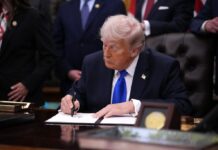




















Despite requests from the president for support, many traditional U.S. allies have stayed on the sidelines. Donald Trump has responded with threats and humiliation.
One month before the United States launched its military offensive against Iran, the U.S.’ most vital global partners convened at the World Economic Forum in Davos, Switzerland, and openly scrutinized the reliability of the U.S. as a trusted ally. Canadian Prime Minister Mark Carney warned the other world leaders and prominent business executives that they should resist the urge to “go along to get along, to accommodate, to avoid trouble, to hope that compliance will buy safety.”
Carney stated clearly: “It won’t.”
Those diplomatic cracks have only deepened over the course of the six-month war as President Donald Trump uses the same tone of threats as leverage against allies and adversaries alike.
When Trump started the war, Israel was the only nation to join the U.S. in battle. Since then, Trump has scoffed at the unwillingness of America’s traditional global allies to contribute to both military and logistics support against Iran.
Instead, America’s longtime military, diplomatic and trading partners have only further solidified their postures shunning the U.S. — heeding the urgings of Canada’s Carney. In response, Trump has abruptly shifted the U.S. further toward isolationism rather than reassuring weary allies.

Last week, Trump placed new 50% tariffs on a broad range of Canadian goods after the U.S. accused Canada, one of its top trading partners, of discriminating against American products.
Trump called its northern neighbor “among the worst nations in the world to deal with,” adding on Truth Social, “WE DON’T NEED CANADA, THEY NEED US!”
Transportation Secretary Sean Duffy justified the move by mocking Canada and falsely asserting that U.S. security forces “provide their security for them.”
“It’s a country that doesn’t have a military,” Duffy told Fox News. In reality, Canada’s military joined the U.S. effort in Afghanistan after the 2001 terrorist attacks, leading to 158 Canadian soldiers dying in defense of the U.S.
Trump, facing further headwinds in his war effort, also sought to spite ally South Korea for its lack of assistance to the war effort.
“I said, ‘Would you like to give us a little hand? We don’t need help with Iran, but if you’d like, give us a hand with Iran.’ He said, ‘No thanks,’” recounted Trump about a phone call with South Korean President Lee Jae Myung.
The Pentagon subsequently announced that it would cut its joint military exercises with South Korea, held annually to deter North Korea. The cancellation came even as Trump publicly revealed that North Korea “has 57 very powerful nuclear weapons.”
Trump’s criticism of South Korea came less than a year after the country offered lucrative concessions to Trump — $300 billion in American investments and cash — in exchange for slightly lowering the tariff rate on the country, from 25% to 15%.
The expansiveness of Trump’s hostility to allies has extended to its key Gulf partners as well, including Oman, whose diplomatic mediators were integral to the Trump administration’s nuclear negotiations with Iran in the year prior to the Feb. 28 attack.
After Oman announced a temporary plan with Iran to open part of the Strait of Hormuz to traffic, Trump responded, “Oman will behave just like everybody else, or we’ll have to blow them up. … They understand that.”
Notably, Oman tried to steer the Trump administration away from an all-out military campaign against Iran in the summer of 2025, and again before its six-month engagement.
In the 72 hours prior to the Feb. 28 strikes, Omani Foreign Minister Badr Al Busaidi met with special envoy Steve Witkoff and Jared Kushner, Trump’s son-in-law, in Geneva to help the indirect talks with Iran progress toward technical negotiations. Al Busaidi also flew overnight to Washington, D.C., for a last-hour appeal to Vice President JD Vance.

Now, the U.S. strategy — and lack of diplomatic coordination on Iran — is having a direct impact.
Retired Gen. Barry McCaffrey, a retired four-star Army general and an MS NOW national security analyst, suggested in a social media post that the war with Iran has “probably” cost the United States access “to 15 Persian Gulf bases.”
“Iran [is] now poised to control access [of] the Gulf States,” McCaffrey said. “US will have to negotiate new access in western Saudi Arabia, Israel, southern Europe.”
Among the other partners facing intensified pressures from Washington is Turkey, a NATO ally that Treasury Secretary Scott Bessent threatened with hefty tariffs if it, along with other countries, maintained trading relations worth billions with Iran.
The Trump administration’s threats and economic attacks on these partners come as the global oil market reels from months of high prices. At home in the U.S., gas prices for consumers across the country currently sit at an average of more than $4 a gallon — a price point that has become a gas station norm.
At the same forum in Davos last January, French President Emmanuel Macron laid bare his direct assessment that the old global order of the last 80 years is “shifting to a world without rules.” “Imperial ambitions are resurfacing,” Macron said, a nod to Trump’s go-it-alone expansionist motivations.
Just over five weeks after Macron’s and Carney’s speeches warning of an American interventionist future, the U.S. — without informing its European or Gulf allies — launched its military assault on Iran. Six months later, it remains to be seen how vestiges of that global alliance can endure given the absence of the U.S., and its attacks on allies.
Source : https://www.ms.now/news/news-analysis/iran-war-diplomacy-global-alliances-trump-canada-strait-hormuz