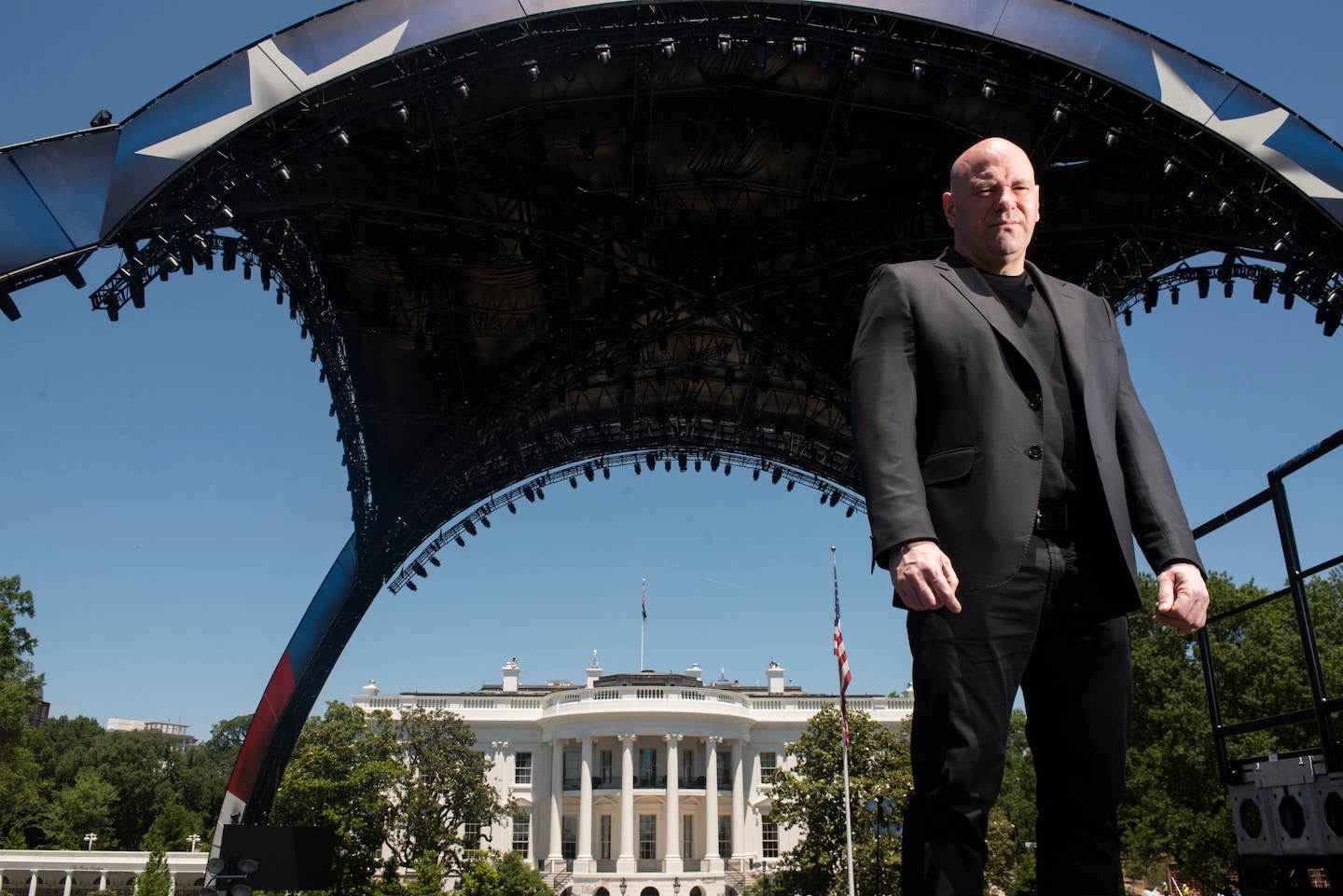
Dana White is walking through the White House Rose Garden one recent morning when he sees the Presidential Walk of Fame, the gallery that the current president installed to honor previous ones. White points out Abraham Lincoln and Teddy Roosevelt, lauding their turns at the helm, and acknowledges that Jimmy Carter, while flawed, “did a lot of good.”
But there’s one portrait that White, the irrepressible chief executive of Ultimate Fighting Championship, can’t get enough of: that of an autopen signing former president Joe Biden’s name, hung by President Donald Trump in place of a headshot of Biden himself.
“You see this, with the autopen?” White says, pointing and chortling. “How funny is that?”
At 56, White is the reigning king of combat sports, having authored perhaps this century’s greatest sports business story by satiating the country’s appetite for intimate displays of violence. Over the course of two decades, he has turned the once unprofitable UFC — famously described by then-Sen. John McCain (R-Arizona) as “human cockfighting” — into a global mixed-martial-arts machine valued at roughly $15 billion.
Through it all, White has proved himself unbeatable, surviving criticism over underpaying fighters and circumnavigating covid-19 restrictions, and skirting scandals such as the video of him slapping his wife, Anne, at a nightclub in 2023, an act for which he has repeatedly apologized. He is not just his sport’s most recognizable and relentless figure but its living embodiment.
“I look at the UFC as this battleship,” White says. “As long as I’m here, we all f—ing go down together, or none of us go down.”
He is also arguably the most powerful man at the intersection of sports and American politics, a status he unlocked in 2016, when he became among the first public figures to endorse Trump’s candidacy. Since then, White, who says he identifies as “an ’80s Democrat,” has spoken at three Republican National Conventions and played a critical role in turning out young, male voters for Trump, including convincing podcaster and UFC broadcaster Joe Rogan to endorse him in 2024. If the “manosphere” has a spiritual leader, it may be White.
White speaks next to President Donald Trump in West Palm Beach, Florida, in November 2024. (Brendan McDermid/Reuters)
Now, wandering the White House grounds, he is days away from what could be his magnum opus: UFC’s Freedom 250, a slate of mixed-martial-arts brawls to be staged on the White House’s South Lawn, in celebration of the nation’s 250th anniversary. It will air on Paramount+ on Sunday, the 80th birthday of the president who suggested it.
The makeshift arena will hold 4,000 invited guests, and a watch party on the Ellipse, the park adjacent to the White House, can hold 85,000 more. Critics have sued the Trump administration, alleging the event is unlawful. The event was initially expected to cost $60 million, covered by UFC, but those costs have risen, UFC executives have said, and it is expected to lose $30 million.
For White, though, the event marks the culmination of a 25-year stretch during which UFC — with assists from Trump — put a chokehold on American culture. Costs, criticism, lawsuits: It’s all worth it.
“Everybody talks about me doing this event with Trump,” he says. “But you think if any of these other presidents had reached out and said, ‘We want to do a fight on the White House lawn,’ I wouldn’t do it?”
That’s how White, on a weekday morning 11 days before his event, is moving around the White House grounds like he works there. After the garden, he spends a few minutes in the Roosevelt Roombefore walking to the Oval Office. The president sees him and smiles.
“I hate to say it, but I don’t know if he’s a replaceable person,” Trump says of White, sitting across the Resolute Desk from his friend of 25 years.
“I sort of think everyone’s replaceable. Of course, I’m not replaceable as president,” he continued.
“But I’m not sure that Dana is replaceable.”
White separates Nate Diaz, left, and Conor McGregor during a 2016 weigh-in event in Las Vegas. (Ethan Miller/Getty Images)
A punch and a path
White’s brand of masculinity is reflected in the barroom next to his office at UFC Headquarters in Las Vegas: Air Jordans spread out across the bar, a box of Cuban cigars, two sports Emmys, a glass case with two handguns gifted by Kid Rock and a framed photo of Steve Jobs.
Sitting there one day in May, he is laughing about a video of Trevor Noah, the comedian and former host of “The Daily Show,” reflecting on the importance of male vulnerability. The video was the topic of discussion in his group chat that morning. He shakes his head and mutters, “This is the craziest thing.”
“The world is a mean, nasty, ugly place; it is. … You can’t be weak,” White says, leaning forward in his chair. “Every day, we’re competing. Somebody wants what you got, and they’re f—ing coming for you, so you have to deliver.”
In trying to explain how he got here, White prefers not to psychoanalyze the early days of his life — whether it’s his dad’s drinking, or his public falling-out with his mother, or getting expelled from his Las Vegas high school for kicking open a classroom door, nearly injuring a nun.
Instead, he points to a night in the late 1980s. He was working as a bouncer at the Black Rose, a popular Irish pub in Boston, a city where he twice attended and quickly dropped out of college. A customer wouldn’t stop trash-talking; he walloped the guy twice in the face. The resulting police report led to him getting fired, he says.
“I had gotten into all these fights for this bar, and this one thing happens to me, and you fire me?” he recalls. “I’m like, ‘I will never, ever give this much of myself to somebody else again.’”
Fighting is in his DNA, he says. (Actually, he says it’s in everyone’s.) Around the same time, when White was about 19, Peter Welch, a boxing trainer in Southie, hit White with the hardest punches in Welch’s life, Welch says. It’s White’s greatest strength as a fighter, the trainer says: taking a punch. The more Welch talked to him, the more he felt White’s relentless ambition. White routinely said he wanted to take what he learned at McDonough Gym and make it global.
“He wanted to take over the world,” Welch says.
White with fighter Chuck Liddell in 2008. (Eric Jamison/AP)
By the late 1990s, White was training mixed-martial-arts fighters, including early stars Chuck Liddell and Tito Ortiz. But UFC was on life support. After McCain compared the sport to “human cockfighting” in 1996 and sent letters to state governors asking them to ban mixed martial arts, the American Medical Association said it supported a moratorium. A nationwide ban never happened, but UFC was $44 million in debt and struggling to get on pay-per-view, its mix of brutality and unseriousness pegged as a freak show rather than sport.
In stepped White. He convinced his high school classmate Lorenzo Fertitta and Fertitta’s brother Frank III, who co-founded Station Casinos, to purchase the downtrodden circuit for $2 million, handing White a 10 percent stake.
“Part of his success was that he had a very intimate knowledge of what the product needed to be,” says Lorenzo Fertitta, UFC’s CEO until 2016. “We needed a fighter who knew the fight game and knew what the fans wanted.”
The first event under his direction was UFC 30, in Atlantic City in 2001. Venues were squeamish after McCain’s verbal takedown. No one took them seriously — except the Trump Taj Mahal.
White presents an award to Matt Hughes in 2003. (Ed Mulholland/WireImage)
Trump didn’t know White, and he planned on leaving after the first fight or two. But he couldn’t turn away, he says, from “one of the most incredible things, because I had never seen anything like that before.”
“I said, ‘You got to be kidding,’” Trump recalls in the Oval Office. “It was a level of excitement that you don’t see. It was crazy.”
Over the next decade, fueled by the success of Spike TV’s reality-competition show “The Ultimate Fighter,” stars such as Conor McGregor, Ronda Rousey and Jon Jones became household names. UFC’s media rights deals skyrocketed, from $35 million to $100 million to $3 billion, eventually leading to Hollywood mogul Ari Emanuel’s WME-IMG agency — which later became Endeavor and then TKO — buying the organization for more than $4 billion in 2016.
“It took one night of fights to get us hooked,” says Mark Shapiro, the president and chief operating officer of TKO, the parent company of UFC.
Through it all, the friendship between White and Trump grew, with Trump often sending handwritten congratulatory notes in the margins of newspaper clippings.
“You have people that you know are rooting for you, and he was always that guy,” White says of Trump. “This was before the world hated Donald Trump.”
When the world changed, Trump had a favor to ask his friend in 2016.
“If you don’t want to do this, I completely understand,” White recalled Trump saying to him, “but I would be honored if you would speak for me at the Republican convention.”
“Everybody told me not to do it,” White says now. “Why would I not do it?”
The UFC octagon on the White House’s South Lawn. (Maxine Wallace/The Washington Post)
Help off the mat
Inside Trump’s gold-trimmed,still-ivy-less Oval Office, there is no shortage of distractions. When you don’t hear the construction crews working on the UFC’s 92-foot-tall, stars-and-stripes-and-steel venue on the South Lawn, a symphony of hammers, saws and jackhammers booms from Trump’s $400 million ballroom.
Trump had suggested the fight. They were at a UFC event at Madison Square Garden in November 2024 when the newly reelected Trump leaned into White and suggested they put on a fight at the White House.
“I kind of laughed it off, to be honest with you,” recalls Craig Borsari, the chief content officer of UFC, “and then, I noticed Dana wasn’t laughing.”
In the Oval Office, Trump gleefully talks about a call he says he had with Amazon executive chairman Jeff Bezos, who owns The Washington Post, about Bezos maybe coming to the fight. (Bezos’s spokesman declined to comment). Later, Trump muses about his customized Sharpies and brags about the size of the renovated, “industrial-strength” Lincoln Memorial Reflecting Pool, telling an aide to bring a laptop to show off a graphic that reads, “Our Pool is Bigger than Skyscrapers.”
White, Trump and UFC executive Hunter Campbell appear on screens at an April event in Miami. (Tasos Katopodis/Getty Images)
Trump and White at the Miami event. (Tasos Katopodis/Pool/AP)
Trump says he has White and the UFC fans to thank, in part, for being back in the Oval Office. If not for the adulation he received from UFC crowds — which he calls “MAGA all the way” — he might not have made another run at the White House, he says.
“I wouldn’t say I was the flavor of the day,” he says of that era, which he describes, oddly, as the “Never-Never Land” stage of his political career. “I went to a fight and still did my walk-in with [White,] and the place went crazy.”
“It was sort of the reason I said, ‘Well, I didn’t lose,’” he adds, casually floating his baseless stolen-election theory regarding the 2020 vote. “I guess I got to try it a third time, right?’”
From Trump’s view, loyalty is the defining, nonnegotiable pillar of both his and White’s governing styles. That superpower helped fuel one of White’s most lucrative business decisions: to keep holding events through the pandemic. He had the barren sports landscape mostly to himself, and UFC’s popularity surged.
“I would rather f—ing die of covid than hide in my house and f—ing wipe out half my staff,” he said later.
White counts a lot of influential men as dear friends. The surfer Kelly Slater and Mark Zuckerberg, the CEO of Meta, where White is a board member, both marveled in interviews at White’s ability to power through outside criticism.
“It wasn’t always accepted,” Zuckerberg says, “but he had the fortitude” to build it into something “beloved” — including by Zuckerberg himself, who built an octagon in his yard.
White and Trump have repeatedly leaned on each other at critical moments. In 2023, amid a conservative backlash to Bud Light, a UFC sponsor, promoting transgender actress Dylan Mulvaney, White convinced Trump to urge people to give Bud Light a second chance.
The next year, with Trump fighting to return to the White House, White called in a favor that may have helped swing the election.
Before Rogan was America’s most popular podcaster, he was — well, a lot of things, but none inspired more of his passion than UFC commentator. He’s been close with White for as long as Trump has, and White knew a Rogan endorsement would help. He says he worked for six years to convince Rogan.
White and UFC commentator Joe Rogan in 2006. (Frazer Harrison/Getty Images for Spike TV)
“For all the heat he gets, Rogan is a liberal,” White says. “Joe Rogan was going to vote for f—ing Bernie Sanders!”
Then, on the eve of the 2024 election, after Trump went on Rogan’s show for three hours and Vice President Kamala Harris did not, Rogan finally endorsed Trump.
Through a spokesperson, Rogan declined an interview request. He has been critical of Trump in his second term, especially around Iran, and of the idea of an outdoor fight, calling the White House event “odd,” despite being on the broadcast.
Even as Trump’s popularity has fallen to all-time lows, White has stood by him. He was at the White House correspondents’ dinner when a gunman stormed it in April, catching criticism for calling the experience “awesome.” A month later, though, he doubles down, noting he would have felt differently if anyone ended up being hurt: “It was pretty incredible.”
He argued to the New Yorker last month that Trump can’t be racist, given his past friendship with Michael Jackson. He also bristled at the suggestion, from Charlamagne tha God on “The Breakfast Club”radio show, that White was “a glazer” and “a yes-man” who couldn’t tell his friend how he was failing the American people.
White poses for a photo with a fan near the White House on Friday. (Brendan Smialowski/AFP/Getty Images)
The UFC boss points to a Metro bus Friday bearing a UFC Freedom 250 advertisement in D.C. (Brendan Smialowski/AFP/Getty Images)
“For anybody to think that I would ever go to the Oval Office and talk to him about Iran, it’s just crazy talk,” White says in Las Vegas, adding, “I don’t glaze.”
“I live in my UFC bubble over here,” he goes on. “I run my business, and I have all my own f—ing problems.”
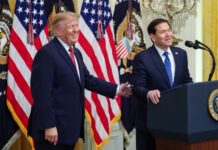
White has repeatedly stated he wants nothing more to do with politics once Trump is out of office. But when asked what he would say if Vice President JD Vance or Secretary of State Marco Rubio — considered the two early potential GOP front-runners for 2028 — asked him for help to win the presidency, White suggested he might not be totally out.
“The problem is, I have a really good relationship with Rubio. We’re actually friends, too,” White says, laughing. “I don’t know. I don’t know. That’s [assuming] they would even come to me. Who knows? But I amvery close to Rubio.”
In the Oval Office, Trump ponders how much bigger White can get after Sunday’s spectacle.
“You’ll never have anything like this again,” Trump says of Sunday’s fight. When he suggests one of the only ways White could go higher is if he follows in his footsteps and runs for office, the UFC president grins and shakes his head.
“Dana, this is the bad part,” Trump jokes. “You can only go down from here.”
White under “the Claw” on the White House lawn. (Louie Palu/Panos Pictures/For The Washington Post)
The view from the top
White is 40 feet above the White House lawn, atop the stands of what is temporarily the most famous sports site in America.
At this point in early June, there’s still work to be done. The octagon won’t be constructed until right before the event, and seats have not yet been installed. Pest control could be an issue: Ever since having dinner at the Rose Garden last month, White has been consumed thinking about the clusters of gnats, a fixture of D.C. summers, that could make the fights more of a technical and logistical nightmare than they already are. Also: The forecast calls for thunderstorms.
The response on the lawn Sunday night should be strong, though Trump’s stranglehold on the culture has cracked of late. A judge has ruled his name should be stripped from the Kennedy Center. After several musical performers slated for the Great American State Fair on the National Mall canceled, Trump made himself the headliner. When he appeared on the Jumbotron at Madison Square Garden, where he was cheering on his hometown Knicks during the NBA Finals, he was loudly booed.
That was the NBA. This is UFC, in Trump’s actual backyard, where White is, for the first time all day, suddenly almost speechless. He looks out on the Mall, then turns around to marvel at what he and his friend built.
“What do you think?” he asks. “Pretty crazy, huh?”
The arena glows outside the White House on Thursday. (Alex Brandon/AP)