




























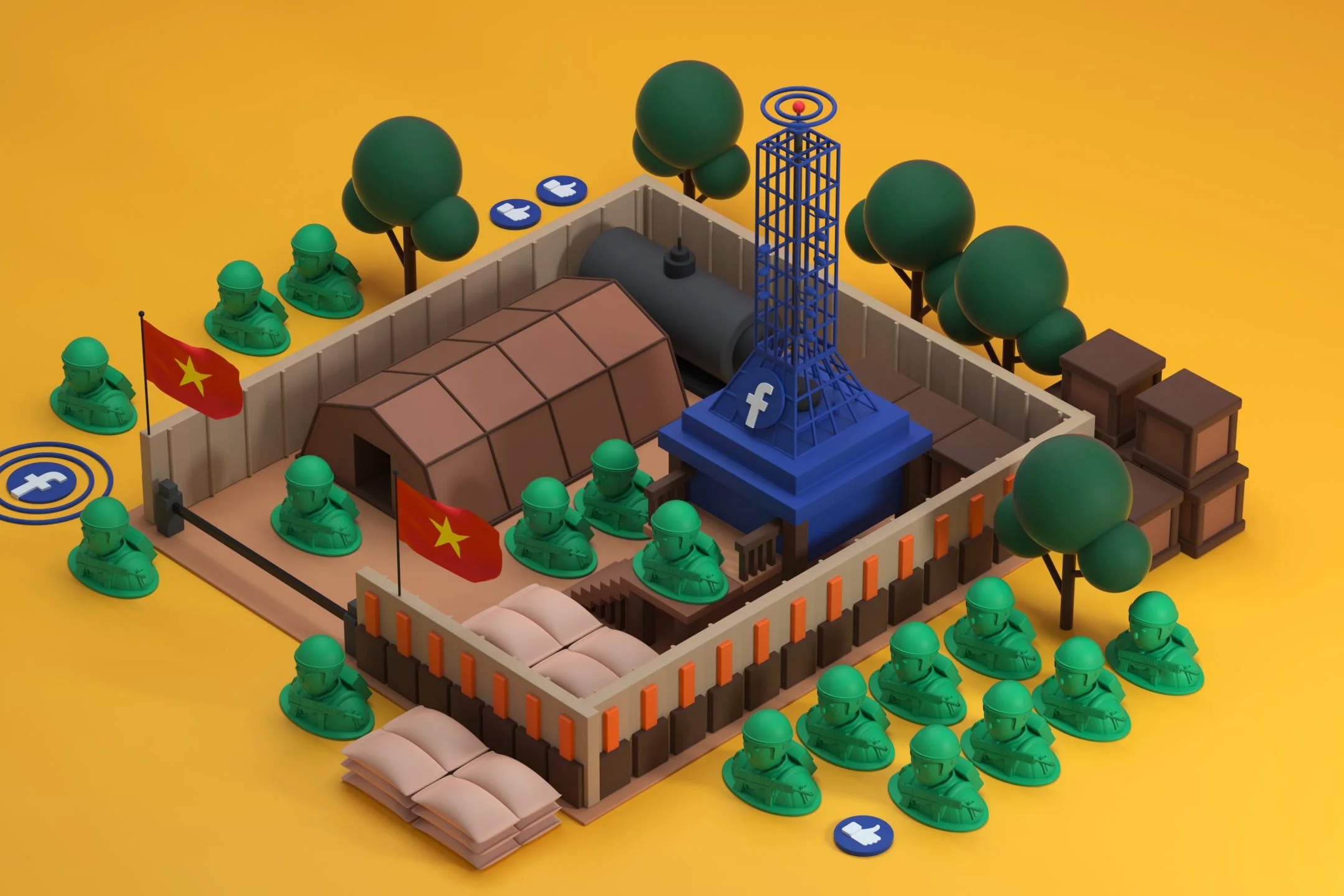
Lực lượng 47 lạm dụng các công cụ an toàn của Facebook để làm câm lặng những người chỉ trích chính phủ trong nước và trên toàn thế giới.
-
Tác giả: Danielle Keeton-Olsen
-
Nội dung chính: Nhóm do quân đội hậu thuẫn thao túng các công cụ kiểm duyệt của Facebook để dập tắt các ý kiến trái chiều. Các chiến dịch báo cáo hàng loạt (mass-reporting) nhắm vào các bài viết tiếng Việt không chỉ giới hạn trong biên giới Việt Nam. Dù Facebook tuyên bố đã triệt phá một mạng lưới gây hại, nhưng các nhà hoạt động cho biết tình trạng quấy rối chưa bao giờ dừng lại.
Những “vết sẹo” kỹ thuật số
Khi nhà báo và blogger Nguyễn Văn Hải (Điếu Cày) biết tin về rắc rối tại một ngân hàng quốc doanh Việt Nam vào tháng 2, ông đã hành động ngay lập tức. Tin tức từ các hãng thông tấn tiếng Anh cho biết ngân hàng này bị một nhóm đầu tư châu Âu cáo buộc trộm cắp và rửa tiền. Ông dịch các báo cáo sang tiếng Việt và chia sẻ lên nơi mà những người theo dõi ông có thể thấy.
Đầu tiên, ông Hải đăng lên hai trang tin nhưng không lan tỏa rộng. Sau đó, ông chia sẻ bản dịch lên Facebook, và một điều “ám muội” đã xảy ra: Bài viết bị gắn cờ vi phạm tiêu chuẩn cộng đồng, khiến ông bị khóa tài khoản trong ba ngày. Ông Hải không có cách nào biết ai đã báo cáo mình, hay có bao nhiêu vi phạm, nhưng ông biết đây là một kịch bản quen thuộc: riêng trang cá nhân của ông đã nhận 31 “gậy” vi phạm chỉ trong hai năm 2019 và 2020.
“Hiện tại, trang cá nhân của tôi bị bóp tương tác, bạn bè trong nước không thể thấy bài đăng của tôi,” ông Hải nói.
Từng bị bỏ tù gần 7 năm tại Việt Nam với nhiều cáo buộc, bao gồm “tuyên truyền chống nhà nước”, ông Hải chuyển đến Los Angeles vào năm 2014 ngay sau khi ra tù. Nhưng bằng cách nào đó, sự kiểm soát của chính phủ đối với phát ngôn trực tuyến đã theo chân ông qua bên kia bờ Thái Bình Dương. Mỗi khi ông đăng nội dung chỉ trích chính phủ, nó thường bị báo cáo và gỡ bỏ. Đến khi ông khôi phục được tài khoản, dòng thời gian của tin tức đã trôi qua.
Sự trỗi dậy của Lực lượng 47
Vào ngày Giáng sinh năm 2017, Bộ Quốc phòng Việt Nam công bố sự tồn tại của một nhóm quân đội chuyên giám sát internet có tên là Lực lượng 47. Trong những năm qua, các tài khoản thân chính phủ đã hiện diện liên tục, hoạt động khá tự do trên các nền tảng lớn như Facebook và YouTube.
Tại Việt Nam, cuộc chiến này diễn ra chủ yếu bên ngoài các kênh pháp lý thông thường. Trong nửa đầu năm 2022, Facebook báo cáo có gần 1.000 lượt gỡ bỏ dựa trên luật pháp địa phương — con số này cao hơn mức trung bình nhưng vẫn ít hơn nhiều so với các nước láng giềng. Tuy nhiên, các con số này được cho là đã che giấu một chiến dịch báo cáo hàng loạt hung hãn hơn đối với bất kỳ ai nghi ngờ chính phủ.
Michel Trần Đức, giám đốc vận động của Việt Tân, cho biết ông phải tranh chấp vi phạm tiêu chuẩn cộng đồng trên Facebook ít nhất mỗi tháng một lần. Đây là một quy trình chậm chạp và khó khăn. Khi một bài viết vi phạm luật phát ngôn địa phương, Facebook thường chỉ hạn chế hiển thị tại quốc gia đó, nhưng một vi phạm tiêu chuẩn cộng đồng bị báo cáo hàng loạt sẽ khiến bài viết bị gỡ bỏ trên toàn cầu.
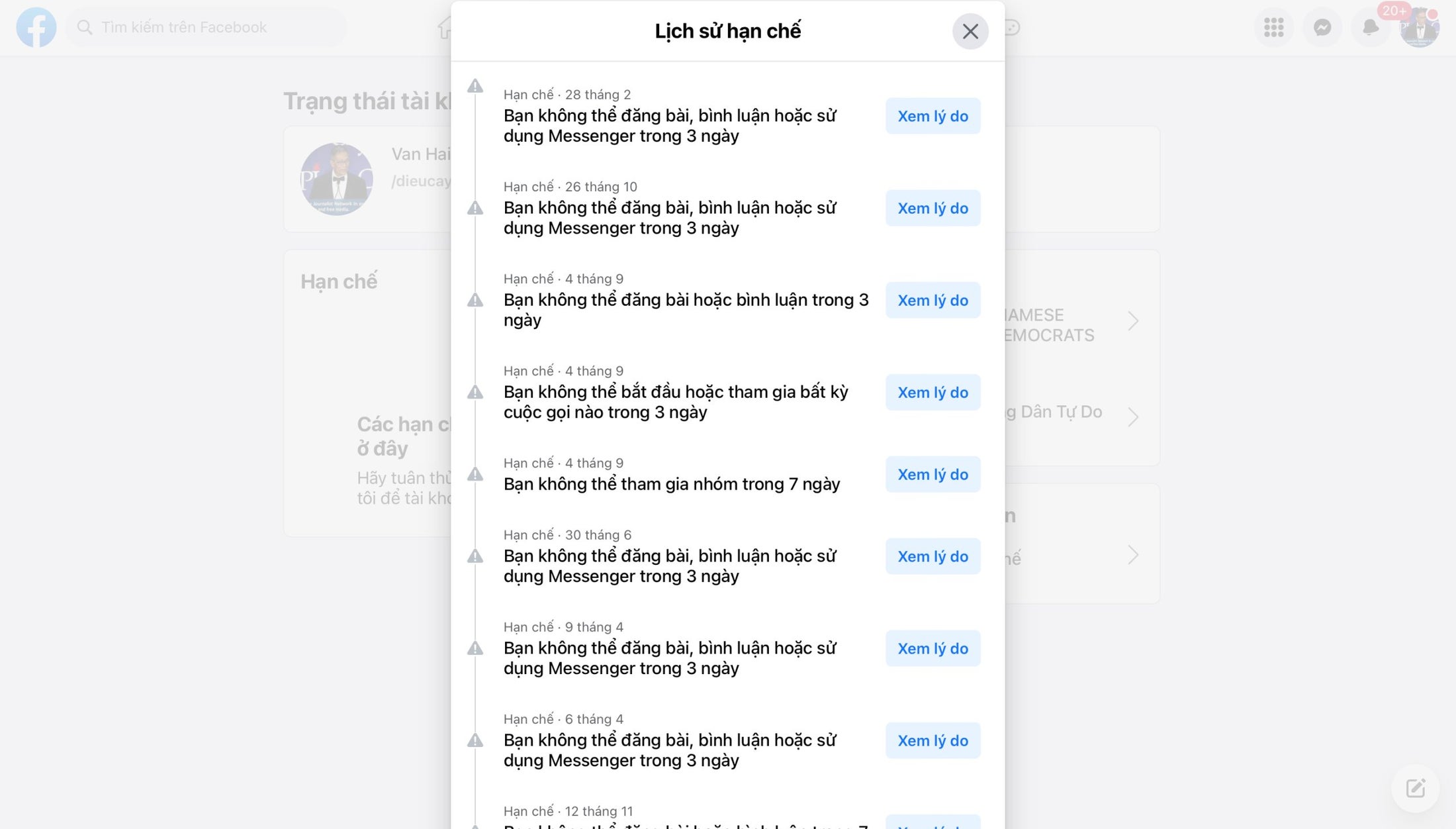
Vũ khí hóa “Tiêu chuẩn cộng đồng”
Khiết Ngân, người dẫn chương trình V5TV, nhận thấy các vi phạm lặp đi lặp lại đã khiến hồ sơ của bà bị ẩn đi. Bà nghi ngờ trang của mình đã bị hạ bậc ưu tiên trên bảng tin (feed). Khoảng một năm trước, một nhóm “troll” bắt đầu tấn công bà bằng những từ ngữ thô tục nhưng chưa bao giờ bình luận về nội dung chương trình. Sau đó, tương tác giảm mạnh từ hàng nghìn lượt xem xuống còn vài trăm. Người hâm mộ nhắn tin nói rằng họ không còn nhận được thông báo khi bà phát trực tiếp.
Nguyễn Thế Phương, một chuyên gia về an ninh quốc phòng, nhận định Lực lượng 47 rất khó truy vết vì họ hoạt động trên mạng xã hội bằng các hồ sơ giả, phối hợp để lan truyền nội dung thân chính phủ và nhắm mục tiêu vào những người bất đồng chính kiến.
Áp lực lên Meta
Hà Nội không ngại cứng rắn để duy trì kiểm soát. Năm 2020, Việt Nam từng bóp nghẹt lưu lượng truy cập Facebook trong 7 tuần sau khi công ty này từ chối yêu cầu gỡ bỏ các bài viết của các nhà hoạt động. Cuối cùng, Meta đã phải xác nhận đồng ý hạn chế các nội dung mà chính phủ coi là bất hợp pháp.
Meta cho biết trong một email gửi Rest of World: “Nếu chúng tôi tiếp tục phản đối các yêu cầu này, rất có thể nền tảng của chúng tôi sẽ bị chặn hoàn toàn tại Việt Nam.”
Tháng 12/2021, Meta tuyên bố đã giải tán một mạng lưới tại Việt Nam chuyên báo cáo hàng loạt các nhà hoạt động. Các nhà hoạt động xác định đây là một nhóm kín có tên E47 với hơn 10.000 thành viên. Tuy nhiên, nhiều người cho rằng việc gỡ bỏ này là quá ít và quá muộn. Ca sĩ, nhà hoạt động Đỗ Nguyễn Mai Khôi chia sẻ rằng cô đã bỏ cuộc trong việc báo cáo lại các tài khoản tấn công mình: “Họ biết mọi người sẽ dễ dàng tạo tài khoản mới. Khi Facebook xóa nhóm E47, chúng tôi biết những người đó sẽ sớm bắt đầu lại từ đầu.”
The Vietnamese military has a troll army and Facebook is its weapon
Force 47 abuses Facebook’s safety tools to silence government critics at home and anywhere in the world.
By DANIELLE KEETON-OLSEN
8 MAY 2023
The military-backed group manipulates Facebook’s moderation tools to silence dissenting speech.
Focused on posts written in Vietnamese, the mass-reporting campaigns reach far beyond Vietnam’s borders.
Facebook says it took down a nefarious network in Vietnam, but activists say the harassment never stopped.
When journalist and blogger Van Hai Nguyen learned about trouble at Vietnam’s state-owned bank in February, he sprang into action. News had broken on English-language newswires that the bank was being accused of theft and money laundering by a European investment group. He translated the reports to Vietnamese, and went to disseminate the news where his followers could see it.
Nguyen first posted to two news sites, but those didn’t reach far. Then, he shared the translation on Facebook, and something sinister happened. The posts were flagged for platform violations, creating enough of a stink to lock him out of Facebook for three days. Nguyen has no way to find out who flagged his post, or even how many community standards violations he received, but he knows this is a pattern: his page got 31 strikes alone in 2019 and 2020 alone.
“Currently, my personal page is being squeezed, my friends in the country can’t see my posts,” he told Rest of World. Nguyen was imprisoned for almost seven years in Vietnam on different charges, including for spreading “anti-state propaganda.” He moved to Los Angeles in 2014, shortly after he was released – but somehow, the Vietnamese government’s hold over online speech has followed him across the Pacific. Often when he posts something on Facebook that’s critical of the current government, it’s reported and taken down. By the time he can restore his account, the news cycle has moved on.
It’s a bitter lesson, but one he’s learned well. “Facebook is no longer a safe place to express opinions and criticize the wrongdoing of the Vietnamese government,” Nguyen said.
On Christmas Day 2017, Vietnam’s defense ministry announced a military group devoted to policing the country’s internet, called Force 47. In the five years since, pro-government trolls have been a persistent presence on the side of the regime, operating more or less freely across major platforms like Facebook and YouTube. As speech laws tighten in countries like India, Turkey, and Thailand — and platforms lose interest in pushing back — the trolls consistently and successfully harass activists and journalists posting on Vietnamese Facebook, providing a troubling model for how censorship can flourish within social media, even reaching beyond national borders.
In Vietnam, the fight has taken place largely outside the usual channels of law enforcement requests and court orders. In the first half of 2022, Facebook reported just under 1,000 takedowns based on local laws in Vietnam — above average, but still far fewer than neighbors like Taiwan, Thailand, and Indonesia. Over the same period, Facebook reported only one government request for user data within the country. By conventional measures, the Vietnamese government is not doing that much to restrict its citizens on Facebook.
But according to local opposition groups, activists and reporters, these numbers conceal a far more aggressive campaign of mass reporting of any groups that question or critique the government. Michel Tran Duc, the advocacy director for the pro-democracy group Viet Tan, told Rest of World he has to dispute a community standards violation on Facebook at least once a month. Michel is then forced to appeal the decision through Facebook — a slow and difficult process.
After enough successful appeals, Michel got the email address of a Meta human rights manager based in Washington, D.C., who is typically able to intervene and get the content restored. But while individual posts can be restored, there hasn’t been enough action on the broader problem.
“We’d like to check with [the manager] about the complaints [to the Viet Tan Facebook page] and what is the real issue with these reports,” Michel said. “We hope that someday we can discuss directly with the Facebook team.” Because the reports refer to broad platform violations and don’t officially come through legal channels, they reach much farther than a conventional government request. When a post violates local speech laws, Facebook typically only restricts it from being shown within that country — but a mass-reported community standard violation will take it down globally. It can even reach content like Nguyen’s translation, which was posted from outside Vietnam.
Khiet Ngan, the host of Vietnamese language news and interview show V5TV, said she noticed the repeat community standard violations she receives had effectively hidden her profile, suspecting her page got demoted in the Facebook feed.
She first noticed her pages getting targeted around a year ago, when a swarm of trolls began calling the Australia-based vlogger a prostitute or a loser, but never commenting on the actual content of her show, she said.
Then her engagement on Facebook started to drop off, from fans and trolls alike. Her livestreams used to get thousands of views in April 2022, which plummeted to a few hundred on each stream this month. She said fans in Vietnam and Australia began to message her, saying they no longer get notifications when she goes live.
If we continued to push back on these requests, it is highly likely our platforms would be blocked in their entirety.”
“You have to keep disputing [reports] while doing your work,” she said. “It’s very tiring actually but we have the confidence that what we’re doing is right and it gives us motivation, we know we’re doing a good job because if we’re not then they don’t bother.”
The trolls that weaponize Facebook community standards show the versatility and adaptivity of Vietnam’s domestic digital security unit Force 47, as it attempts to assert its grip over online spaces, in addition to the physical world, said Nguyen The Phuong, an expert on Vietnam’s defense and maritime security. Force 47 is hard to trace because its realm is social media, where users can make fake profiles and inflate or obscure their credentials, but Phuong and other researchers have seen evidence of coordinated attempts to spread pro-government content to manipulate the online dialogue, as well as target dissidents on social media – as they seem to do with community standard violations.
“They’re doing all things at the same time, not just restricted to one approach,” he said.
Hanoi has not been afraid to flex in order to maintain control, blocking Facebook in 2020 after the company initially refused to comply with government takedown requests targeting activists critical of the government. In early 2020, Vietnamese networks began intensely throttling traffic to Facebook, rendering the site nearly unusable for seven weeks. After the throttling was lifted, Reuters reported on a tense negotiation between Meta and the Vietnamese government in the weeks leading up to the block. Ultimately, Meta confirmed that it had agreed to the government’s demands, telling Reuters it would now “restrict access to content which [the government] has deemed to be illegal.”
That incident still affects how aggressive Facebook’s moderation can be within the country. Company representatives cited it when reached for comment about this story. “We pushed back on demands to silence peaceful political speech in Vietnam for several years, and explored every option to ensure people could still express themselves as freely as possible,” Meta said in an email to Rest of World. “However, as we shared in 2020, if we continued to push back on these requests, it is highly likely our platforms would be blocked in their entirety.”
Phuong said he believed that the government will take a direct approach – filing a takedown request to Meta – when targeting more prominent users, and other times the Force 47 trolls can deploy methods of controlling information that make the social media seem more organic.
He described this as a contrast to China’s internet censors, which ban Facebook and other foreign social media in favor of domestically-developed platforms, built to accommodate the state’s censorship demands. “In Vietnam we’re flexible in living within Western social media,” he said, adding that “it’s better that there are still places for Vietnamese people to voice their dissent [on certain topics].”
Facebook sometimes pushes back against groups of mass-reporters, but it rarely makes a lasting impression. In December 2021, Meta said it had dispelled a network in Vietnam for mass-reporting content from activists and government critics. The company described the threat as a network of real and fake accounts that was reporting its targets hundreds, if not thousands, of times. Activists identified this network as a closed Facebook group called E47, which contained more than 10,000 members, including military officials and citizens. Several had successfully infiltrated the now-defunct E47 at its peak, and witnessed users coordinating plans to target specific posts or Facebook users — always attacking those who opposed the party line.
But for many in the opposition, the takedown was too little, too late. Do Nguyen Mai Khoi, an activist and singer who has been targeted by the same troll force, told Rest of World she gave up on reporting trolls to Facebook after the 2021 report. “What they did made me more frustrated because they didn’t solve the problem from the root,” she said. “They know people will create a new account easily. So when they removed the E47 account, they announced it, but we knew the same people would start it again.”
Source : https://restofworld.org/2023/force-47-vietnam-military-group-facebook/


