

































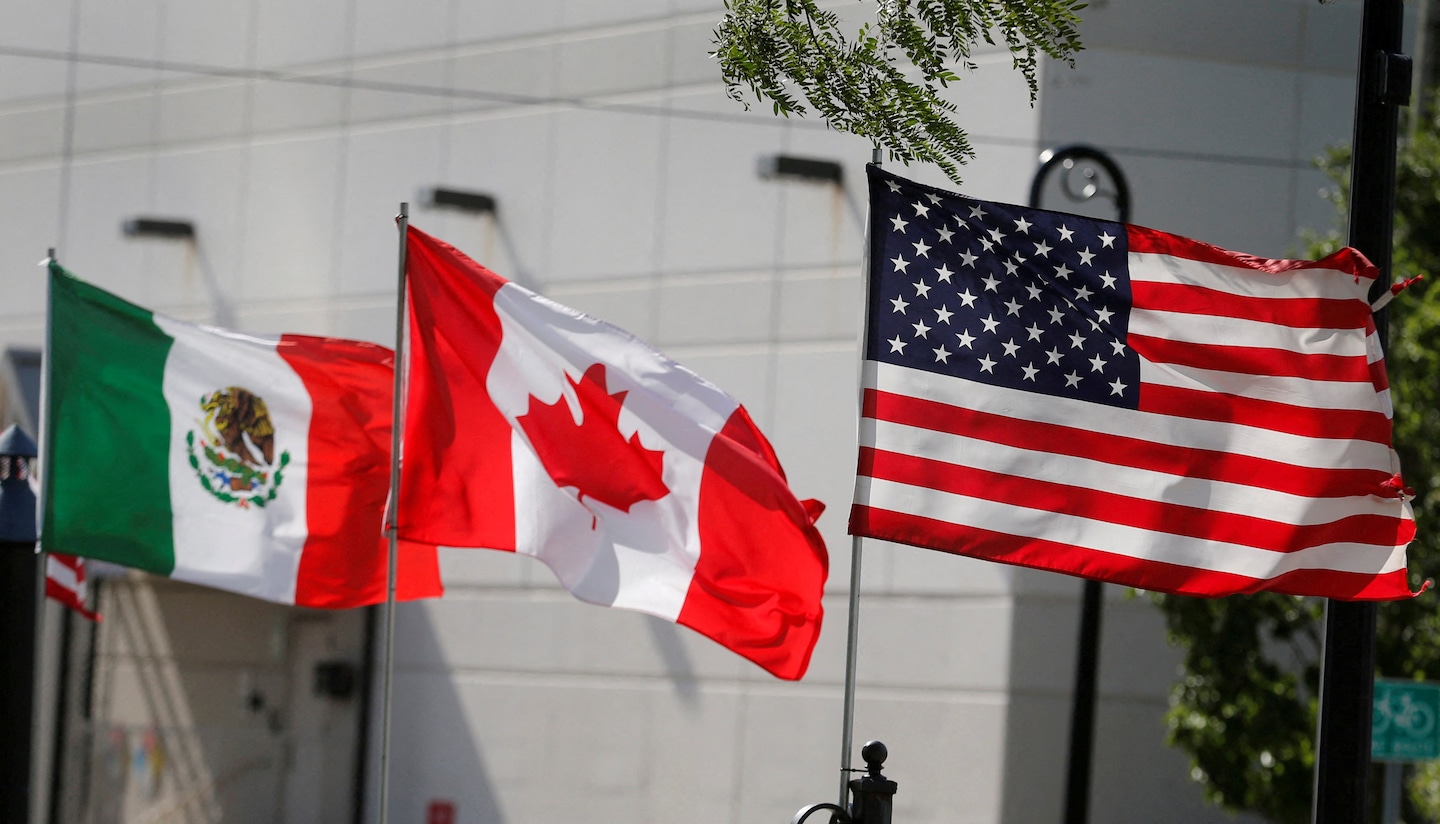
The Trump administration will not extend the USMCA trade deal, instead choosing further talks aimed at securing improvements.
The United States refused to extend its trade pact with Canada and Mexico by Wednesday’s deadline, instead kicking off a process that could result in a refreshed agreement or an investment-sapping succession of annual reviews.
Under the 2020 U.S.-Mexico-Canada Agreement, the three countries had until Wednesday to extend their deal for 16 years or continue negotiating potential revisions. U.S. and Mexican officials are scheduled to hold their third round of talks the week of July 20 in Mexico City.
Official discussions with Canada have not yet begun. Relations between Washington and Ottawa have been cold over the past year, amid President Donald Trump’s gibes about making the U.S. neighbor the “51st state” and Canadian retaliation for U.S. tariffs. If no agreement is reached, the North American trade deal would be subject to annual reviews for a decade before expiring in 2036, an outcome few anticipate.
On Wednesday, Jamieson Greer, the chief U.S. trade negotiator, conducted a required treaty review during a virtual meeting with his counterparts in Mexico and Canada. The U.S. blocked a potential extension and “will continue to engage with Mexico and Canada to address the Agreement’s shortcomings and our trade deficits with these countries,” Greer said in a statement.
“Theoretically, they could do this every year for the next 10 years. But I believe the administration wants to get this done by the end of the year,” said Dan Ujczo, a trade lawyer in Columbus, Ohio.
For more than three decades, U.S. presidents from both parties pursued a model of regional trade premised on reducing or eliminating most tariffs on goods moving among the three North American nations.
But Trump scrapped that approach and imposed new tariffs on goods from Canada and Mexico, affecting steel, aluminum, copper, heavy vehicles and other goods that are not governed by USMCA. The administration views those actions as more significant than the update of the tripartite trade deal that Trump secured in his first term.
“The president has already changed the dynamic between U.S., Canada, and Mexico. He’s already, I would say, subsumed USMCA under new trade and tariff policies,” said a senior administration official who spoke on the condition of anonymity to brief reporters.
Just six years ago, Trump celebrated USMCA at a White House ceremony as “the largest, fairest, most balanced, and modern trade agreement ever achieved.” But now he routinely denigrates the accord, suggesting he might withdraw the U.S. from it and upend nearly $2 trillion in annual goods and services trade.
Irked by a growing trade deficit with Mexico, Trump wants new terms that would bring more auto manufacturing to the United States and limit China’s ability to dodge U.S. tariffs by shipping goods to U.S. customers via Mexico. Canada and Mexico hope to escape Trump’s second-term tariffs but seem unlikely to secure complete relief.
Prolonged uncertainty about North American trade rules would have little effect on the U.S. economy but would probably depress investment in its two neighbors, a possibility that leaves the Trump administration unfazed. Companies that are worried about the risks of investing in Canada or Mexico should build new factories in the U.S., the senior administration official said.
The prospect of a partial rewrite of USMCA, which replaced the 1994 North American Trade Agreement (NAFTA), may already be causing boardroom doubts. U.S. foreign direct investment in Mexico last year was $15.9 billion, down slightly from $16.5 billion in 2024.
Limiting China’s backdoor access to the U.S. market is a key part of the USMCA rethink. Mexico already has raised tariffs on Chinese imports. The Trump administration now wants to secure a common stance on export controls and investment limits affecting China.
“For national security reasons … I want to have our supply chain sourced from this hemisphere … from North America. That’s where we want to have it,” Greer told a Council on Foreign Relations audience in May.
U.S. automakers have the most at stake in the ongoing review. Vehicles manufactured by companies such as General Motors and Ford cross the Mexican and Canadian border several times before being completed. So USMCA’s tariff-free treatment is vital to their operations.
Trump’s trade policies already have hurt the domestic production he champions, industry executives said. U.S. factories making vehicles and parts have shedmore than 21,000 jobs since USMCA took effect.
Under the “reciprocal trade” deals that the administration has reached with Japan, South Korea and the European Union, it is less expensive to ship vehicles produced in those markets to the U.S. and pay the required tariff than to produce them in the U.S., industry executives said.
Plus, many Japanese models sold in the U.S. — such as the Nissan Armada and Toyota Land Cruiser — contain no American components, according to the National Highway Traffic Safety Administration.
“U. S. automakers currently face a disadvantage. … We urge a swift and durable resolution that ensures a level playing field and provides long-term certainty needed for capital-intensive automotive investments,” said Matt Blunt, president of the American Automotive Policy Council.
In the USMCA revamp, administration officials have proposed requiring half of a vehicle’s components be made in the U.S. for it to receive lower tariffs. The U.S. also is pushing to increase the percentage of North American content to more than 80 percent from 75 percent today.
Auto executives have said they would struggle to comply with the higher targets. After decades of offshoring, some auto parts, such as wiring harnesses, are not available in large volumes domestically.
The White House, saying it continued to work with the industry, defended the president’s approach.
“No president has done more to revive the American auto industry than President Trump, who has championed an aggressive agenda of auto tariffs, rapid deregulation, tax cuts, and even a new tax deduction on interest payments for Made-in-USA autos,” said Kush Desai, a White House spokesman.
As the White House pursues an updated deal, some industry representatives complain they have lost their traditional access to the negotiations. Official charters for 16 industry trade advisory committees expired earlier this year.
The administration said in May that it would appoint new industry panels “imminently.” But until it does, executives who previously were cleared by the government to see draft agreements as they were negotiated and to offer suggestions are in the dark, they said.
“The administration has not shown that they’re willing to engage in a comprehensive, structured way with industry, and I hope that does not lead to subpar outcomes in terms of trade policy,” a manufacturing executive said.