











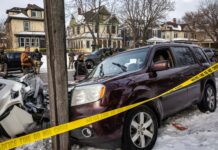





























Sound training tells officers to step out of a vehicle’s path rather than fire into it and DHS policy bars deadly force to stop someone from driving away.
The lawsuits filed this week by the survivors of Renee Good, who was shot dead Jan. 7 by Immigration and Customs Enforcement agent Jonathan Ross in Minneapolis, make the general claim that Ross had no reason for killing the 37-year-old mother of three. But plaintiffs make two more specific allegations that particularly trouble me as a 40-year law enforcement veteran who trained other officers.
The lawsuits say at least one ICE agent told Good, who was in the driver’s seat of an SUV, that she could leave the scene where ICE agents were working at about the same time other agents were ordering her out of her car. The lawsuits also allege that agents at the scene not only failed to provide aid to Good after she was shot but also stopped a doctor from trying to help her.
These are but allegations. The government has claimed Ross fired in self-defense because he feared she was about to run over him with her vehicle, and a court may eventually decide whether he was justified. But the allegations that Good was given conflicting orders and denied medical aid after she’d been shot describe failures I’ve seen before and know have no place in professional policing.
The allegations that Good was given conflicting orders and denied medical aid after she’d been shot describe failures I’ve seen before and know have no place in professional policing.
As someone who has led police officers, I have defended them when they are right. I know a vehicle can kill an officer as surely as a gun can, and agents are right to respect that. But that’s why sound training tells officers to step out of a vehicle’s path rather than fire into it. The Department of Homeland Security’s own policy bars deadly force used simply to stop someone from driving away. Video taken at the scene suggests Ross got in front of Good’s car when he didn’t have to.
According to the Good survivors’ lawsuit, in the incident in question, “ICE agents got out of their vehicle, with one instructing: ‘Out of the car. Get out of the f—ing car.’ On information and belief, another ICE agent gave Renee an instruction to leave the scene.”
Put yourself in Good’s seat. One officer says go. Another says get out. A third has a hand on your door. Whatever you do, you are disobeying someone. And whatever you do can later be called resistance. Good trainers teach one rule for this: one voice. When several officers approach a subject, one gives commands and the others cover. That is not courtesy. It is tactical. A person given conflicting orders cannot comply, and officers who give them cannot predict what happens next. Confusion breeds fear. Fear breeds gunfire.

Minnesota is familiar with allegations of conflicting commands. In 2016, a St. Anthony police officer pulled over motorist Philando Castile who answered affirmatively when the officer asked him if he was armed. (Castile had a permit to carry a handgun.) Seconds later, the officer fired seven shots into Castile’s car and shouted, “I told him not to reach for it.” Castile’s girlfriend, who was in the passenger seat, responded, “You told him to get his ID, sir, his driver’s license.” The police officer was later acquitted of manslaughter, but St. Anthony, without admitting blame, settled with Castile’s family for nearly $3 million to avoid a federal wrongful death lawsuit.
When commands cannot be obeyed, they stop being commands. They become a pretext. I don’t believe most officers set such a trap on purpose. But the person in the car pays the same price either way.
The allegation that agents denied Good medical aid after she was shot and prevented others from helping is even harder to stomach, but it is supported by bystander video that was reported by newsrooms in January. Included in that video was a person asking if he could help Good and telling the ICE agent he was a physician. The agent responded, “I don’t care.”
The allegation that agents denied Good medical aid after she was shot and prevented others from helping is supported by bystander video that was reported by newsrooms in January.
I’ll be candid. One of Ross’ bullets entered Good’s temple and exited the other side of her head. It is unlikely any doctor on that street could have saved her. But that grim fact changes absolutely nothing about the duty to aid. No one at that scene knew the wound was fatal.
At the time, a DHS spokesperson defended the agents’ lack of aidby saying Good did not have a pulse. But officers are neither physicians nor coroners. Duty requires them to begin aid, or allow it, until someone qualified takes over. DHS own use-of-force policy calls for medical assistance for people injured by force.
Again, this is an issue Minneapolis already knows a lot about. In 2020, as Minneapolis police officer Derek Chauvin kept his knee planted on George Floyd’s neck, an off-duty Minneapolis firefighter begged officers to let her check Floyd’s pulse. They refused to let her do so. Her testimony helped convict Chauvin.

There is a deeper point. What officers do after force is used tells the public who they are. An officer who fires and then rushes to stop the bleeding shows that force was used to end a threat, not to punish a person. Officers who wave off a doctor send the opposite message.
Nearly nine months later, no one has been charged in Good’s death. The Department of Justice declined to open a criminal investigation, and Minnesota officials have accused federal agencies of withholding evidence. DHS said it launched an investigation into the shooting, but no details or updates have been released, and the status of that investigation is unclear. DHS did not immediately respond to MS NOW’s questions about the probe.
Good’s brother Brent Ganger summed it up: “No accountability, no investigation, no expression of condolence, no change in policy.”
Civil court is the one door still open to this family. Good’s brother Brent Ganger summed it up: “No accountability, no investigation, no expression of condolence, no change in policy.”
The fixes are not radical. Federal agents should be trained and required to use one designated voice for commands. They should render aid or let qualified bystanders do it once a scene is secure. Supervisors should answer when either rule is broken. Every well-run police department I know already works this way.
Being firm and being humane are not opposites. Law enforcement officers are expected to be both. Renee Good deserved clear instructions and a fighting chance. According to her family, she got neither. That is not law and order. It is only force.
Cedric Alexander
Cedric Alexander, a former commissioner of community safety in Minneapolis, is a law enforcement expert with over 40 years of experience in public safety. Alexander has also been deputy commissioner of the New York State Division of Criminal Justice Services and an assistant professor at the University of Rochester department of psychiatry. He is a former national president of the National Organization of Black Law Enforcement Executives (NOBLE). He is the author of “The New Guardians: Policing in America’s Communities for the 21st Century” and “In Defense of Public Service: How 22 Million Government Workers Will Save Our Republic.”
Nguồn : MS NOW