





































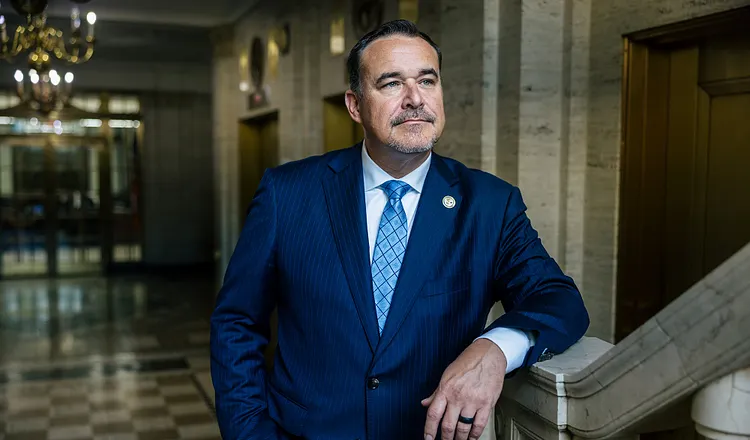
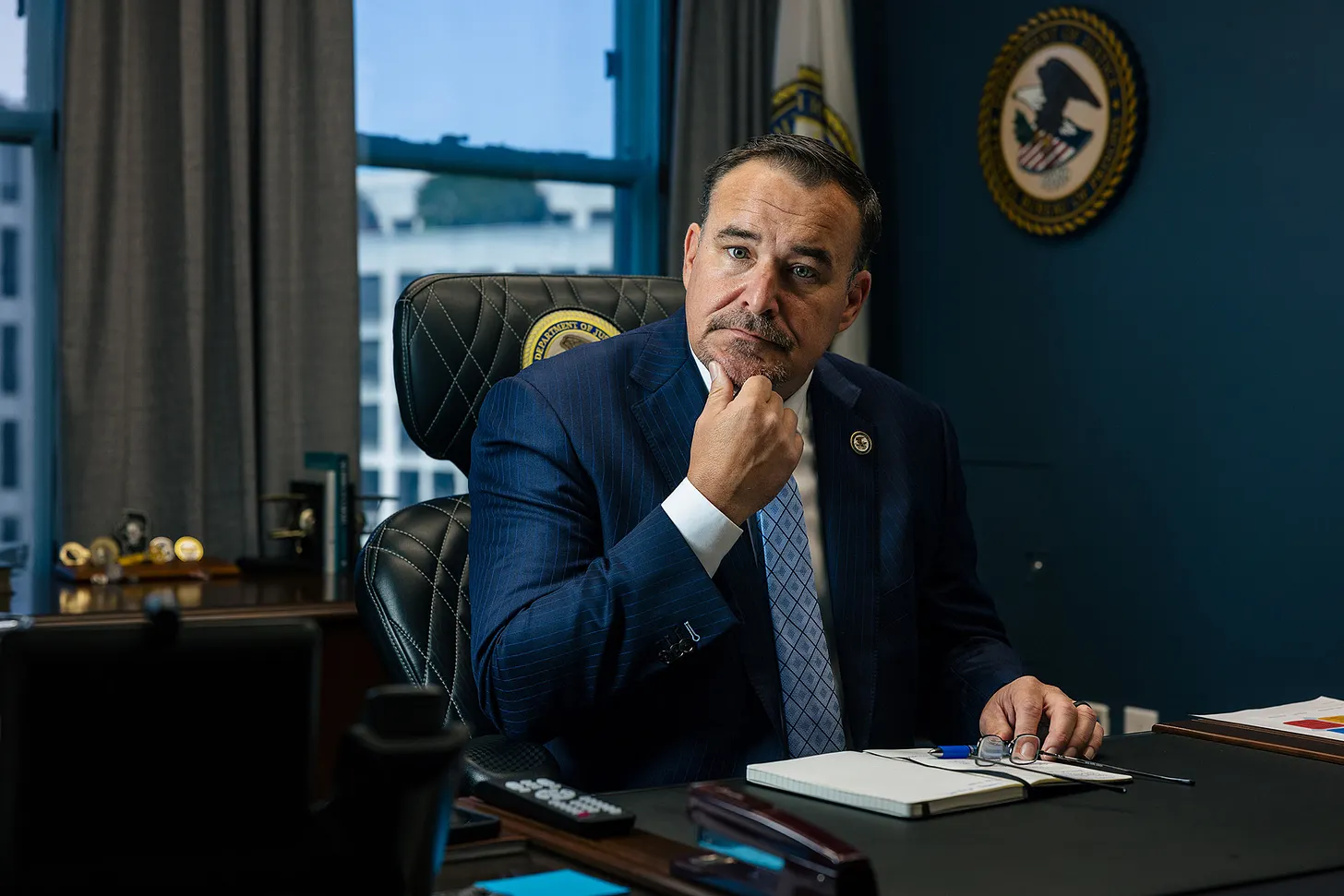
Josh Smith, 51, spent this past Christmas in prison. Just like he did for five years after being caught at the age of 21 in possession of a kilogram of cocaine and 150 pounds of marijuana. The difference? Smith wasn’t behind bars anymore. A year ago this month, he was sworn in as deputy director of the federal Bureau of Prisons (BOP), one of the world’s largest prison systems.
During the holidays, he made three unannounced prison visits with his wife to thank corrections officers for reporting to work and sacrificing their family time. Just showing up also meant that prison wardens didn’t have a chance “to start painting any walls” or do other tidying up before Smith arrived, he told me.
The next big stop of the holidays was another sign of how much Smith’s life has turned around: He rang in the new year at Donald Trump’s Mar-a-Lago resort in Palm Beach, Florida. It was the president who pardoned Smith in 2021 during the last week of Trump’s first term, almost two decades after Smith completed his prison sentence.
The White House said Smith had “dedicated his life to his faith and to his community” and to “making prison ‘a place of transformation’ ” through his Fourth Purpose Foundation, which advocates for criminal justice reform. The pardon was supported by Tennessee’s governor, other top state officials, and “numerous other community and faith leaders.”
“What stood out from the beginning was not just that he rebuilt his own life, but how seriously he has taken the responsibility to help others do the same,” said Alice Marie Johnson, another former federal inmate who received a pardon from Trump in 2020 and is now the White House “pardon czar.”
What might be even more significant is what Smith’s rise says about the president’s surprising and often overlooked approach to criminal justice. While Trump projects toughness on crime, he has arguably supported more criminal-justice reform than any other American president in modern history.
During his first term, Trump signed into law the First Step Act, which allows federal inmates to shorten their sentences through good behavior and has reduced prison overcrowding. The law was meant to reverse tough-on-crime excesses like the 1994 crime bill passed under President Bill Clinton, which resulted in a huge surge in the prison population, especially among black Americans, and few release valves for draconian sentences. When President Barack Obama left office in 2017, federal prisons held over 185,000 people. Since then, the total has declined to 154,000.
People released under the First Step Act are more likely to stay out of prison for good. An analysis by the Council on Criminal Justice found that the percentage who wound up back in prison was about 55 percent lower than similar people who were released before the law was passed.
Nevertheless, the BOP—which also has 34,000 employees, 122 facilities, and an $8.4 billion budget for the current fiscal year—remains troubled, resistant to change, and plagued by low morale. It was ranked four years in a row as the worst federal agency to work.
Smith’s mission is to use what he learned on the inside of the federal prison system, and what he accomplished after getting out, to improve the BOP as much as he can.
“I think till I’m dead, I’ll be helping people figure out what the model of corrections should look like,” he said.
In a video introducing himself to BOP wardens and assistant wardens, Smith said: “I can support you, and I can empower you in your roles. And I can remove those among you that aren’t the type of leaders this agency needs.”

“He is a man of action. And if you’re not, move out of the way,” said Heather Rice-Minus, CEO of Prison Fellowship, a Christian nonprofit that serves prisoners, former prisoners, and their families. Because of Smith’s success before becoming deputy director, “He doesn’t need this job, so that puts him in a position to take action and make tough choices in an unprecedented way.”
Still, his appointment by William Marshall III, who started as the BOP’s director two months earlier, was met with indignation from some insiders aghast that a former inmate had become its deputy director. “Having a prior-convicted felon as the second-in-command at the bureau is just unbelievable,” a corrections union official told The Marshall Project. “The morale was down and low to begin with, but now you’ve got people that want to get out of the bureau ASAP.”
Marshall said that Smith “knew that he was going to be a target and an easy target, yet he agreed to come in anyway with me.”
Since his appointment, Smith has shown up at prison after prison: 64 facilities so far, including those three at Christmas. He solicits questions, ideas, and criticism—and sizes up management. He is also quietly overhauling who works in the prison system. So far, Marshall and Smith have replaced 90 wardens and assistant wardens out of the BOP’s total of several hundred. Smith told me that the agency needs to be less of a “good old boys’ club.”

Smith’s theory of improving how prisons operate centers on prison-level leadership and staff morale. “You take and put the right warden in place, it’s amazing the changes that can happen,” he said. And if corrections officers are overworked and undertrained, they will be miserable and much more likely to take out their misery on inmates.
As for those inmates, because of what Smith has experienced himself, he can have “a different type of accountability conversation with them,” he said. “I can say, ‘I want the best for you, but I’m also willing to hold you accountable. . . . ’ They receive that differently from someone that has been there.”
The reforms can’t come too soon. My own incarceration for four and a half months in 2024 at Federal Correctional Institution (FCI) Ashland in Kentucky, about 150 miles from where Smith was imprisoned two and a half decades earlier, was more than long enough for me to see myriad ways in which the BOP was dysfunctional. (Trump granted me a full and unconditional pardon last year, and the Supreme Court unanimously vacated my convictions this year.)
One snapshot of those problems: I remember brushing my teeth one morning at the communal bathroom sinks in my housing unit when the guy next to me, who was being released later that day, said to me: “This place is called a federal correctional institution. Tell me, did I miss the correctional part? There’s nothing at all correctional about prison.”
Looking back now, Smith finds it easy to understand how he wound up as what he calls a “young, punk, drug-dealing kid.” He was born in Clarksville, Tennessee, to a mother in her early 20s. By the time he was 2, his parents had divorced, and his father moved away. His mother remarried, and Smith was excited about getting a second shot at having a father figure. But a new chapter of darkness and tumult arrived.
The stepfather was physically abusive. “That was a really tough period for me, wanting the love of a father, but not really understanding what was going on,” he said. (Authorities discovered the abuse when Smith was 11.)
He soon ran away from home and wound up in a residential facility, surrounded by teenagers who also had experienced trauma and reinforced each other’s worst instincts. Their collective attitude was, as Smith put it, “The world’s not giving me anything, so I’m gonna take it.” By 16, he had been charged with 10 felonies for burglary and theft. He also had a child.
Smith got a second chance because he was a minor. But at 21, he was caught with the cocaine and marijuana that got him locked up. “The federal government did not like my entrepreneurial abilities,” Smith said wryly, “and they decided to shut my enterprise down.”
Looking back now, Smith finds it easy to understand how he wound up as what he calls a “young, punk, drug-dealing kid.”
When he walked into the FCI Manchester minimum-security prison camp in Kentucky wearing an orange jumpsuit in November 1998, he believed his life was over. He had been married for one year and left behind the couple’s 6-year-old son and 18-month-old daughter.
In one of his most despairing moments, Smith encouraged his wife, Tracy, to leave him. She told her husband that she wasn’t going anywhere.
Early in his sentence, another inmate approached him to talk. Smith still remembers cursing out the man for no reason other than to project his own toughness. On the inside, though, “I was dying,” he said. That night, Smith prayed to God simply and desperately, “Here I am.”
The next day felt different. God was moving in his life, he told me. Another shift came from exposure to white-collar inmates, the first time Smith, a high school dropout, had been around educated professionals. These men from polished backgrounds weren’t necessarily smarter than he was, Smith realized. They had just grown up with more resources and opportunities.
He decided to use those inmates as professors in his prison version of an MBA program. When a banker arrived, “I just went and started . . . asking if he would talk to me about banking. And that’s where I learned about credit and finance.” He also walked the prison’s track with a former CEO who clearly felt like “a fish out of water,” peppering him with business questions. Smith got together with a group of inmates to learn about the stock market.
Listening to Smith reminded me of a sentiment I heard from a man I was incarcerated with who went by the nickname “Smooth” and was serving a long drug sentence. While Smooth and I were playing basketball on the cracked asphalt court one day, he said, “The difference between prison and the outside is that here, where we’re all kind of equal and in the same boat, I can have a conversation with a white-collar business guy and get some career mentoring from him, whereas on the outside I’d never even have access to someone like that.”
Smith also began reading voraciously. “I don’t like reading, but I found myself reading a lot because of the information I gained,” he said. “If you’re reading, it’s like you’re a part of the entire world. You’re free.” Because of Smith’s newfound determination, prison turned into the most transformational period of his life.
“Prison time for me shifted into an educational time,” Smith said, “rather than just . . . doing time.”
After five years, Smith was released in March 2003. His first job out of prison, working at a local hardware store in the same small city, paid him $6 an hour. But he had a vision and believed in himself. The person who emerged from prison was not the same man who had gone in.
“You can point to your childhood, you can point to all the reasons why you shouldn’t be able to make it,” he said. “And guess what? You’ll be right . . . or you can find those reasons to be able to succeed, and really understand that you’re the one that directs where your life goes.”
Smith started a small business making sure basements were structurally sound and waterproofing them, often hiring recently released inmates. Many of those “second chance” hires showed gratitude and loyalty that were hard to find in other applicants.
In 16 years, Smith’s business grew to over 180 employees and annual revenue of $30 million. He sold it in 2019. In the span of a decade and a half, Smith had gone from a penniless prisoner to a millionaire many times over.
He turned around and founded the Fourth Purpose Foundation, which advocates for criminal justice reform, committing $10 million of his own money toward the cause. The name references the four rationales for incarceration: retribution, incapacitation, deterrence, and rehabilitation. Smith believes that the fourth one—making sure offenders are prepared to rejoin society—is at best neglected and often nonexistent in America’s prisons.
Smith said his life is animated by the question “How do we make prison a place of transformation?”
Fourth Purpose provides faith-based programming and educational content for inmates, corrections staff training to combat burnout, and videos to improve understanding of prisons and humanize those who live or work inside.
In 16 years, Smith’s business grew to over 180 employees and annual revenue of $30 million.
The same year that Smith sold his business and started Fourth Purpose, Tennessee governor Bill Lee appointed him to a task force charged with reducing the high percentage of formerly incarcerated people who wind up back in prison. Lee calls Smith “a trusted friend” and told me that his “story is a remarkable testament of faith, redemption, and purpose.”
But will what worked for Smith also work for the 1.8 million people across the United States who are in state or federal prisons or local jails—and 3.8 million more on probation or parole?
When I asked the corrections union official who criticized Smith’s appointment if his opinion had changed after watching Smith in the job, he declined to comment. Other union leaders did not respond to my requests for comment.
Marshall, the BOP director, sees early signs of real and lasting change. Seventy percent of the agency’s executive team has been replaced since Marshall and Smith took over. “The traditional selections for leadership in the past . . . maybe have not been what has been needed,” he said diplomatically. While Smith said it is too soon to draw conclusions from operational data, the number of lockdowns and canceled prison visits has declined sharply.

Most of the people I spoke to said that they admire Smith’s redemption journey, but some worry that the BOP is extraordinarily hard for anyone to change. “There are major issues within the Bureau of Prisons, and I think those issues are bigger than what one person can fix,” said Shanna Rifkin, general counsel of the advocacy group Families Against Mandatory Minimums. She cited frequent prison lockdowns, rampant sexual abuse, inadequate medical care, and other problems.
I asked some of the men I know in federal prison what they think. The consensus was that they like the idea of a former inmate occupying a leadership position but that the BOP is like a massive cruise ship that cannot quickly change course.
Smith said his aim is “that when [inmates] leave, they do not come back to our institutions. That is our mission. That is why we exist.”
Some leaders in the criminal-justice reform movement worry that Smith will be discarded as a political appointee when Trump’s second term ends. “The kind of transformation he is working toward requires continuity, trust, and sustained leadership,” said Ana Zamora, founder and CEO of The Just Trust, a philanthropic group that supports criminal justice reform. “Regardless of administration or political party, maintaining that continuity would allow the progress already underway to deepen and take root.”
Smith said he has no interest in climbing the political ladder. He has all the freedom and financial independence that he needs, he said, along with a large family that includes four kids and four grandkids, whom he loves spending time with.
But one way or another, he plans to stay close to and involved with America’s prisons. He said that the work is his way of answering the question that he believes many people ask as they are dying: What more could I have done?
“God has been good to me, has pulled me out of the pit,” Smith said. “Who would I be to not be willing to serve him in areas that he would send me?”
Source : The Free Press