





































Historic change in Mississippi
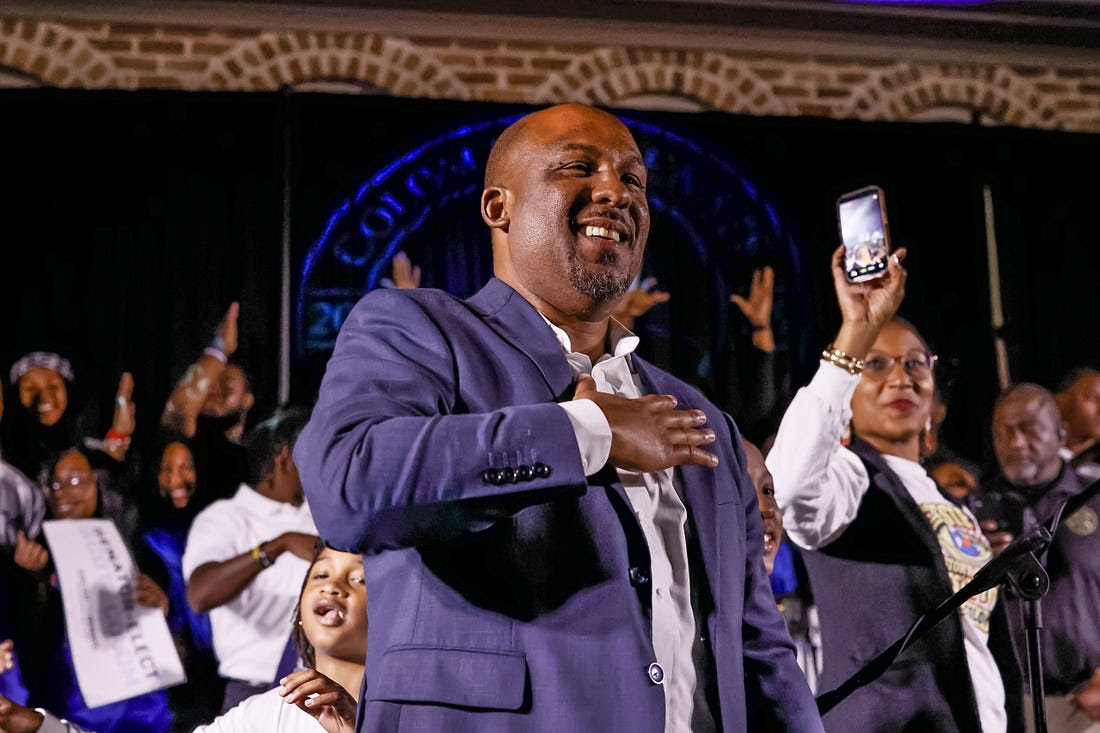
Eight days after one of the most momentous midterm elections in American history, a young Black attorney dismantled one of the most stalwart Republican strongholds in the country. On Wednesday night, the race for Mississippi’s U.S. Senate seat was finally called for Democrat Scott Colom.
Mississippi’s racial divisions have long defined the state. It has only been six years since the legislature retired its 125-year-old flag, emblazoned with the Confederate battle cross.
Colom becomes the state’s first Black senator since 1881, and the very first to be elected in a direct vote by the people. The state’s two Reconstruction-era senators were selected by the legislature.
In a poetic twist of political irony, his opponent, incumbent Sen. Cindy Hyde-Smith, blocked his 2022 nomination to the federal bench. Colom said he likely would not have left a judgeship to run for the Senate.
Many things had to align for Colom to flip the seat.
First, to the surprise of many Democrats and the befuddlement of Republicans, Mississippi was ripe for a change. Unlike some of its hard-right neighbors, recent statewide elections had been close. In 2023, Republican Governor Tate Reeves won reelection by just three points, though Donald Trump won the state by 23 points the following year.
The affordability crisis is hitting Mississippi — the poorest state with the lowest average credit rating — hard. Colom understood this better than his opponent. One of the most viral ads of the 2026 cycle came from Colom’s campaign. In it, Hyde-Smith tells an interviewer who asked about high beef prices that her constituents should “pick another protein.” Incredulous voters in the ad say they would rather “pick another senator instead.”
Colom recognized that Mississippi voters of all persuasions were feeling ignored. He held 70 town halls to listen to their concerns. By contrast, his opponent held few public events. When Trump made a last-minute campaign stop in late October, Hyde-Smith barely spoke. But Colom went to the event, walked the line of waiting Trump supporters, and talked with as many as he could.
Colom patiently, slowly chipped away at decades of immutable Mississippi voters. For months, he had to do it without help from the national party. Eventually, party leaders recognized that he had a shot.
Initially, Colom garnered support from Black Sens. Angela Alsobrooks (D-MD), Cory Booker (D-NJ), and Raphael Warnock (D-GA). Then, in October, the money started to come. Senate Minority Leader Chuck Schumer helped raise funds, and billionaire Governor JB Pritzker of Illinois donated more than $1 million. Next came visits from Vice President Kamala Harris and President Bill Clinton and a campaign ad from President Barack Obama.
Colom capitalized on Black voter anger over the Supreme Court’s April gutting of the Voting Rights Act of 1965, which slashed legal protections for minority voters. Mississippi has the highest percentage of Black residents, at nearly 40%.
Most importantly, he got out the vote in all corners of the state. Colom’s winning map looks very different from the Mississippi of just two years ago. His raw vote total exceeded Harris’, which is almost unheard of in a midterm election, and he won ten counties that Trump carried handily. One of them was Forrest County, named for the first grand wizard of the Ku Klux Klan.
In this election, 99% of black women who voted in Mississippi voted for Colom. Without them, his chances would have been doomed. It is a pattern throughout much of the South these days that in any election, Black women are difference-makers.
But it almost wasn’t enough. Colom won by just 5,686 votes, which is less than a percentage point. It took more than a week to count all the ballots because of the state’s legacy of voter suppression and disenfranchisement.
Last summer, the state election office used year-old data from a credit-rating agency against voter rolls to identify people who might have moved out of state or died. Tens of thousands of active registrations were shifted to inactive without voters’ knowledge.
On Election Day, many of those voters showed up at the polls only to be told they were not properly registered. Their only recourse was to fill out provisional or affidavit ballots. The affidavit ballot then goes to election commissioners to determine eligibility.
David Wilson is one of those voters. He has no idea why he was removed from the voter rolls. “I have been voting in the same place since I have been voting,” the retiree told PBS. Several days after the election, he went to the Hinds County courthouse to make sure his vote was counted.
One is left to wonder how much wider Colom’s victory might have been if not for the voter suppression efforts.
Colom’s win is so significant because it marks a stunning turn in an ugly history. This reporter witnessed Mississippi in another time, though one not so long ago. My first assignment with CBS News in 1962 was to cover the burgeoning Civil Rights Movement across the South.
The beauty of the Magnolia State belied an evil undercurrent that could chill a person’s soul. Racial hatred ran especially deep in the Delta. The violent racism I witnessed changed me as a person and a reporter.
The segregated South meant whites and Blacks couldn’t share the same public spaces, drink from the same water fountains, shop in the same stores, eat in the same restaurants, or attend the same schools. Fewer than five percent of Black children even attended school in Mississippi as late as 1967.
Black people were expected to step off sidewalks to allow whites to pass and to look down when speaking to them. To do otherwise could mean physical punishment, arrest, or worse.
For the 160 years since the Civil War, whites in power have gone to corrosive lengths to suppress their Black neighbors in every aspect of life, especially when it comes to voting. The 15th Amendment, passed in 1870, guaranteed the rights of all Americans to vote, regardless of race.
Mississippi was ground zero for Jim Crow laws that would quickly spread across the post-Civil War South. The goal was simple: consolidate minority white political power by keeping Blacks from voting. And the so-called “Mississippi Plan,” with the Ku Klux Klan at its heart, was born.
And it worked. Between 1875 and 1892, the percentage of registered Black voters in Mississippi dropped from 67% to 6% of those eligible.
Minority whites instituted poll taxes and literacy tests. They held all-white primaries, passed felony disenfranchisement laws, and used other questionable means to keep Blacks from casting a ballot.
A poll tax of a dollar or two a year was more than most Black voters could afford.
Mississippi’s voter “registration” form was actually a literacy test. It included a lengthy section on the state’s constitution that only Black voters were required to “interpret.” Whites were excused from the exercise if they were of “good moral character.”
Also required was a business name and address, so that if a Black person made it through this arduous process, whites then had a list of businesses to boycott.
When Flonzie Brown Wright tried to register to vote in 1963, she was asked “crazy questions” on a two-page, 21-item questionnaire: “How many jellybeans are in a pound of candy?” “How many bubbles are in a bar of soap?” And “How many feathers are on a chicken?” But she “failed” because she didn’t know what habeas corpus meant.
Wright, already a Civil Rights activist, was so incensed by her treatment that, five years later, she ran for election commissioner and won, becoming the first Black woman elected in the state since Reconstruction.
I remember interviewing another young Black woman in the early 1960s who told me about registering to vote. When her employer found out, he insisted she withdraw her registration or be fired.
Brandon Presley, a former Democratic candidate for governor of Mississippi, believes Colom’s win portends a major shift in political tides. “When you look at people who have pent up political desire to make a change, and they finally get that victory, you cannot unring that bell. It foundationally changes Mississippi politics. It shows that we’re not some locked-down red state,” he told the Mississippi Free Press.
The Mississippi of today, Scott Colom’s Mississippi, is one I did not believe I’d live to see. Before this election and its blue wave, and the anti-Trump fever, and the rebuke of his policies, and his wars, and his corruption, the odds against Scott Colom would have been astronomical. But those stars lined up on Wednesday night to give him, Mississippi, and the country a victory.