























A REUTERS SPECIAL REPORT
Filed
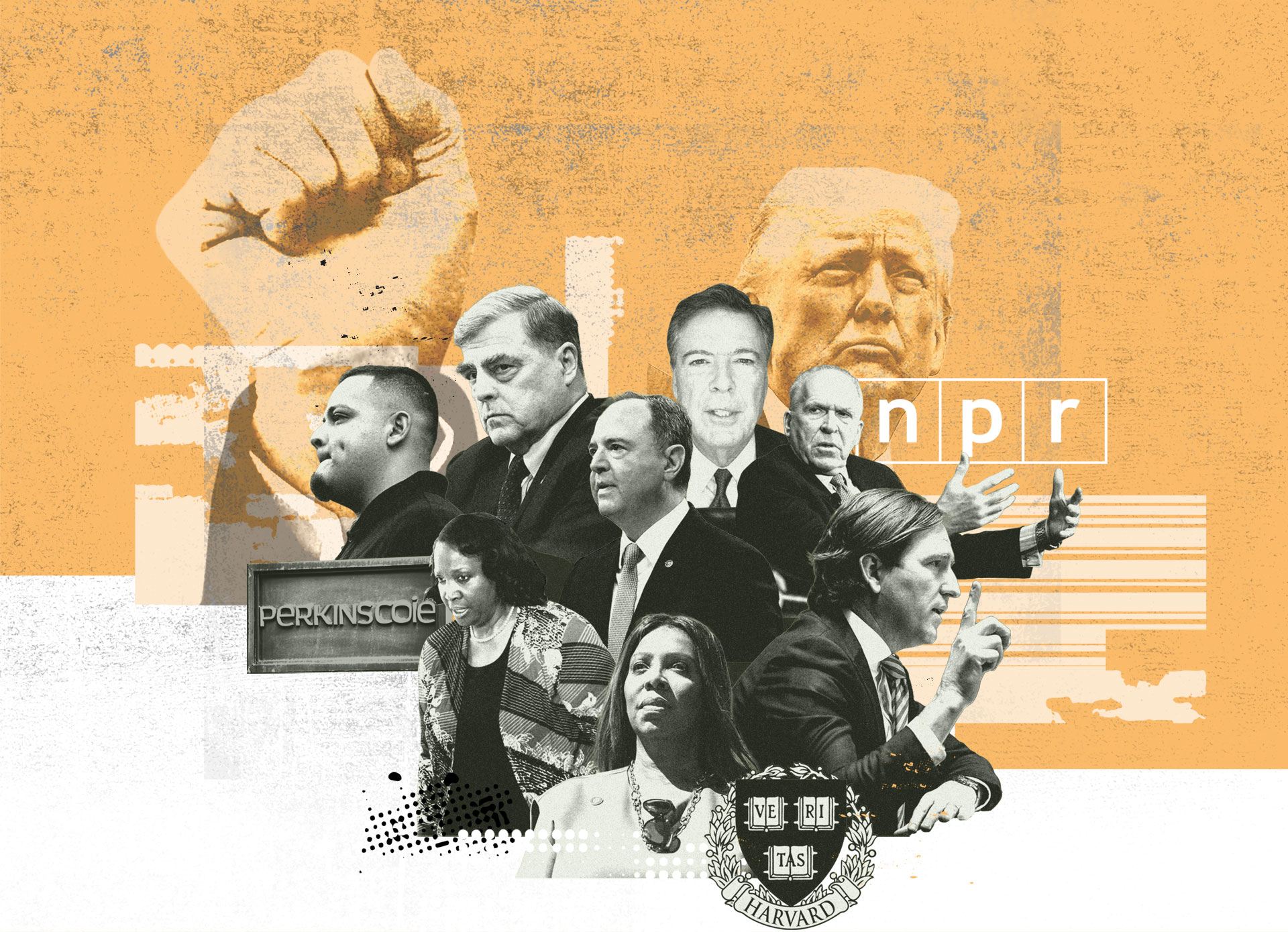
In his second term, Donald Trump has turned a campaign pledge to punish political opponents into a guiding principle of governance.
What began as a provocative rallying cry in March 2023 – “I am your retribution” – has hardened into a sweeping campaign of retaliation against perceived enemies, reshaping federal policy, staffing and law enforcement.
A tally by Reuters reveals the scale: At least 470 people, organizations and institutions have been targeted for retribution since Trump took office – an average of more than one a day. Some were singled out for punishment; others swept up in broader purges of perceived enemies. The count excludes foreign individuals, institutions and governments, as well as federal employees dismissed as part of force reductions.
The Trump vengeance campaign fuses personal vendettas with a drive for cultural and political dominance, Reuters found. His administration has wielded executive power to punish perceived foes – firing prosecutors who investigated his bid to overturn the 2020 election, ordering punishments of media organizations seen as hostile, penalizing law firms tied to opponents, and sidelining civil servants who question his policies. Many of those actions face legal challenges.
At the same time, Trump and his appointees have used the government to enforce ideology: ousting military leaders deemed “woke,” slashing funds for cultural institutions held to be divisive, and freezing research grants to universities that embraced diversity initiatives.
Reuters reached out to every person and institution that Trump or his subordinates singled out publicly for retribution, and reviewed hundreds of official orders, directives and public records. The result: the most comprehensive accounting yet of his campaign of payback.
The analysis revealed two broad groups of people and organizations targeted for retaliation.
The analysis revealed two broad groups of people and organizations targeted for retaliation.

Members of the first group – at least 247 individuals and entities – were singled out by name, either publicly by Trump and his appointees or later in government memos, legal filings or other records. To qualify, acts had to be aimed at specific individuals or entities, with evidence of intent to punish. Reuters reporters interviewed or corresponded with more than 150 of them.
Another 224 people were caught up in broader retribution efforts – not named individually but ensnared in crackdowns on groups of perceived opponents. Nearly 100 of them were prosecutors and FBI agents fired or forced to retire for working on cases tied to Trump or his allies, or because they were deemed “woke.” This includes 16 FBI agents who kneeled at a Black Lives Matter protest in 2020. The rest were civil servants, most of them suspended for publicly opposing administration policies or resisting directives on health, environmental and science issues.

The retribution took three distinct forms.
Most common were punitive acts, such as firings, suspensions, investigations and the revocation of security clearances.

Reuters found at least 462 such cases, including the dismissal of at least 128 federal workers and officials who had probed, challenged or otherwise bucked Trump or his administration.
The second form was threats. Trump and his administration targeted at least 46 individuals, businesses and other entities with threats of investigations or penalties, including freezing federal funds for Democratic-led cities such as New York and Chicago.
Trump openly discussed firing Federal Reserve Chair Jerome Powell for resisting interest rate cuts, for instance. Last week, he threatened to have six Democratic members of Congress tried for sedition – a crime he said is “punishable by DEATH” – after the lawmakers reminded military personnel they can refuse “illegal orders.” This week, the Defense Department threatened to court-martial one of them, U.S. Senator Mark Kelly, a former Naval officer.
The third form was coercion. In at least a dozen cases, organizations such as law firms and universities signed agreements with the government to roll back diversity initiatives or other policies after facing administration threats of punishment, such as security clearance revocations and loss of federal funding and contracts.
It’s a campaign led from the top: Trump’s White House has issued at least 36 orders, decrees and directives, targeting at least 100 individuals and entities with punitive actions, according to the Reuters analysis.
Trump openly campaigned on a platform of revenge in his latest run for the presidency, promising to punish enemies of his Make America Great Again movement. “For those who have been wronged and betrayed, I am your retribution,” he said in a March 2023 speech. Weeks later, while campaigning in Texas, he repeated the theme. “I am your justice,” he said.
Today, the White House disputes the idea that the administration is out for revenge. It describes recent investigations and indictments of political adversaries as valid course corrections on policy, necessary probes of wrongdoing and legitimate policy initiatives.
“This entire article is based on the flawed premise that enforcing an electoral mandate is somehow ‘retribution.’ It’s not,” White House spokesperson Abigail Jackson said. There is no place in government for civil servants or public officials “who actively seek to undermine the agenda that the American people elected the president to enact,” she added. Trump is abiding by campaign promises to restore a justice system that was “weaponized” by the Biden administration, Jackson said, and “ensure taxpayer funding is not going to partisan causes.”
Trump’s actions have been cheered by his staunchest backers. Right-wing commentator and former Trump advisor Steve Bannon told Reuters the use of government power to punish Trump’s enemies is “not revenge at all” but an attempt to “hold people accountable” for what he said were unfair investigations targeting Trump. More is on the way, he said.
“The people that tried to take away President Trump’s first term, that accused him of being a Russian asset and damaged this republic, and then stole the 2020 election – they’re going to be held accountable and they’re going to be adjudicated in courts of law,” he said in an interview. “That’s coming. There’s no doubt.” There’s no evidence the 2020 election was stolen.
“For those who have been wronged and betrayed, I am your retribution.”
Trump’s allies point to actions former President Joe Biden took upon taking office. After Trump’s supporters attacked the U.S. Capitol on January 6, 2021, in a failed bid to overturn his election loss, Biden revoked Trump’s access to classified information, a first for any former president. Biden also won a court battle to dismiss Senate-confirmed directors of independent agencies serving fixed terms, such as the Federal Housing Finance Authority, and removed scores of Trump-era appointees from unpaid advisory boards.
Yet the scale and systematic nature of Trump’s effort to punish perceived enemies marks a sharp break from long-standing norms in U.S. governance, according to 13 political scientists and legal scholars interviewed by Reuters. Some historians say the closest modern parallel, though inexact, is the late President Richard Nixon’s quest for vengeance against political enemies. Since May, for instance, dozens of officials from multiple federal agencies have been meeting as part of a task force formed to advance Trump’s retribution drive against perceived enemies, Reuters previously reported.
“The main aim is concentration of power and destruction of all checks against power,” said Daron Acemoglu, Nobel laureate in economics and a professor at the Massachusetts Institute of Technology, which faces an ongoing federal investigation for embracing diversity and equity programs. “Retribution is just one of the tools.”
Dozens of Trump’s targets have challenged their punishments as illegal. Fired and suspended civil servants have filed administrative appeals or legal challenges claiming wrongful termination. Some law firms have gone to court claiming the administration exceeded its legal authority by restricting their ability to work on classified contracts or interact with federal agencies. Most of those challenges remain unresolved.
Investigating foes of Trump
The administration has moved aggressively against officials in the government’s legal and national security agencies, institutions central to investigations of Trump’s alleged misconduct during and after his first term.
At least 69 current and former officials were targeted for investigating or sounding alarms about Russian interference in U.S. elections. U.S. intelligence agencies concluded soon after the 2016 election that Moscow sought to tilt the race toward Trump, a finding later affirmed by a bipartisan Senate Intelligence Committee reportin August 2020. Acts of retribution tied to the Russia probe include the September 25 indictment of former FBI Director James Comey, a break from Justice Department norms meant to shield prosecutions from political influence.
Comey, who led the FBI’s investigation into Trump’s 2016 campaign, was charged after Trump demanded his prosecution. The Justice Department has cast the case as a corruption crackdown. Comey and his lawyers said in court documents that the case was “vindictive” and motivated by “personal animus.” Comey, who pleaded not guilty, declined to comment. A federal judge dismissed the case on Monday, ruling that Trump’s handpicked prosecutor had been unlawfully appointed.

At least 58 acts of retribution have targeted people Trump viewed as saboteurs of his election campaigns, including Chris Krebs, the top cybersecurity official during his first term. Trump fired him in 2020 for disputing claims that the election was rigged. In April, Trump stripped Krebs’ security clearance and ordered a federal investigation into his tenure. Krebs, still asserting that Trump’s defeat was valid, has vowed to fight the probe. He did not respond for this story.
“This kind of political retribution leads to a loss of trust, which ultimately leads to a failure of governing.”
Reuters documented 112 security clearances revoked from current and former U.S. officials, law firms and state leaders – credentials needed for work that involves classified information. In August, Director of National Intelligence Tulsi Gabbard announced she was revoking 37 clearances.
In a response to Reuters posted on X, an agency spokesperson said Gabbard and Trump are working “to ensure the government is never again wielded against the American people it is meant to serve.” She added: “President Trump said it best, ‘Our ultimate retribution is success.’”
Leon Panetta, CIA director and defense secretary under former President Barack Obama, had his security clearance revoked in January along with others who signed an October 2020 letter suggesting Russia may have been behind reports about emails on Hunter Biden’s laptop. At the time, Joe Biden – Hunter’s father – was Trump’s Democratic rival in the 2020 election. An executive order Trump signed in January claimed: “The signatories willfully weaponized the gravitas of the Intelligence Community to manipulate the political process and undermine our democratic institutions.” Panetta has said he stands by signing the letter.
Panetta told Reuters he had already surrendered his clearance after leaving government nearly a decade ago. Trump’s retribution campaign is hurting CIA morale and wrecking the bipartisan trust that allows Washington to function, Panetta said. “What I worry about is that our adversaries will look at what’s happening and sense weakness,” he said. “This kind of political retribution leads to a loss of trust, which ultimately leads to a failure of governing.” The CIA did not respond to a request for comment.

The revenge effort also reaches deep into the civil service, punishing employees who speak out against Trump’s policies and turning forms of dissent that were tolerated by past administrations into grounds for discipline.
This summer, hundreds of Environmental Protection Agency staffers wrote an open letter protesting deep cuts to pollution control and cleanup programs. The fallout was swift. More than 100 signers who attached their names were placed on paid leave. At least 15 senior officials and probationary employees were told they would be fired. The rest were informed they were under investigation for misconduct, leading to at least 69 suspensions without pay. Many remained out of work for weeks.
“They followed all the rules” of conduct for civil servants, said Nicole Cantello, one of the signers and an officer with the American Federation of Government Employees, a union that represents many affected workers. She called the punishments an attempt to “quell dissent,” stifle free speech and “scare the employees.” In a statement, the EPA said it has “a zero-tolerance policy for career officials using their agency position and title to unlawfully undermine, sabotage, and undercut” administration policy.
At the Federal Emergency Management Agency, about 20 staffers were put on leave and now face misconduct investigations after signing a letter criticizing the agency’s decision to scrap bipartisan reforms adopted years ago to speed disaster relief. Cameron Hamilton, a Republican who served briefly as acting head of FEMA, was fired in May, a day after telling Congress he didn’t believe the agency should be shut down, contradicting the administration.
Hamilton told Reuters he still supports Trump. But he said too many senior officials are firing people in the name of retribution, trying to impress the White House. “They want to find ways to really launch themselves to prominence and be movers and shakers, to kick ass and take names,” said Hamilton. “They’re trying to show the president ‘look at what I am doing for you.’”
In a statement to Reuters, the Department of Homeland Security, which includes FEMA, said it is building a “new FEMA” to fix “inefficiency and outdated processes.” Employees “resisting change” are “not a good fit,” the statement said.
Dr. Jeanne Marrazzo, former head of the National Institute for Allergy and Infectious Diseases, sees her firing in October – three weeks after filing a whistleblower complaint alleging politicization of research and vaccine policy – as a warning shot. She told Reuters the administration’s purge of dissenting health officials is breeding “anticipatory obedience” – a reflex to comply before being asked. “People know if they push back … this is what happens,” she said. The effect, she says, is an ecosystem of fear: those who stay in government self-censor; those who speak out are branded “radioactive, too hot to handle.”
The Department of Health and Human Services, the agency that oversees NIAID, did not respond to a request for comment.
Federal agency leaders have dismissed a wide array of officials they deemed out of step with Trump’s MAGA agenda, including employees involved in diversity, equity and inclusion initiatives and those working on transgender issues.
David Maltinsky, a Federal Bureau of Investigation employee, says he was fired by Director Kash Patel for displaying a Pride flag at work – one of at least 50 bureau personnel dismissed on Patel’s watch. Maltinsky sued the FBI and Justice Department, alleging violations of his constitutional rights and seeking reinstatement. The Justice Department has yet to file a formal response.
In his 2023 book, “Government Gangsters,” Patel named 60 people that he said were members of an “Executive Branch deep state” that opposed Trump, including former Democratic government officials and Republicans who served in Trump’s first administration but eventually broke with him. He called for firings and said that anybody who abused their authority should face prosecution. In his 2025 confirmation hearing before Congress, Patel denied that it was an “enemies list.”

Reuters found that at least 17 of the 60 people on Patel’s list have faced some sort of retribution, including firings and stripping of security clearances. The FBI did not respond to a request for comment.
Against perceived foes in the private sector, the administration has wielded financial penalties as leverage. At least two dozen law firms faced inquiries, investigations or restrictions on federal contracting, often for employing or representing people tied to past cases against Trump. Eight struck deals to avoid further action.
Nine media organizations have faced federal investigations, lawsuits, threats to revoke their broadcast licenses and limits on access to White House events. Trump has also suggested revoking broadcast licenses for networks whose coverage he dislikes.
The targets include universities, long cast by the president and his allies as bastions of left-wing radicals.

Officials froze more than $4 billion in federal grants and research funding to at least nine schools, demanding policy changes such as ending diversity, equity and inclusion programs, banning transgender athletes from women’s sports and cracking down on alleged antisemitism amid pro-Palestinian protests. Five universities have signed agreements to restore funding. Harvard University successfully sued to block a freeze on $2.2 billion in federal aid for the school, which Trump accused of “pushing political, ideological, and terrorist inspired” dogma. Harvard declined to comment.
The administration has described the funding freezes and other efforts to force policy changes at colleges and universities as a necessary push to reverse years of leftward drift in U.S. education. “If Reuters considers restoring merit in admissions, reclaiming women’s titles misappropriated by male athletes, enforcing civil rights laws, and preventing taxpayer dollars from funding radical DEI programs ‘retribution,’ then we’re on very different planes of reality,” said Julie Hartman, a spokesperson for the U.S. Education Department.
A historical parallel: Nixon’s enemies
It’s impossible to predict, of course, how far the Trump revenge campaign will go, or whether it will be affected by a recent slide in popular support. Trump has been hurt by public frustration with the high cost of living and the investigation into late convicted sex offender Jeffrey Epstein.
Nixon resigned in 1974 over the Watergate scandal, in which aides to his re-election campaign broke into Democratic Party headquarters and the president himself later directed a cover-up. While in office, he kept a list of more than 500 enemies. But while Trump has conducted his retribution campaign in the open, historians note, Nixon’s enemies list was conceived as a covert tool.
John Dean, chief counsel in the Nixon White House, wrote a confidential memo in 1971 addressing “how we can use the available federal machinery to screw our political enemies.” The planned methods included tax audits, phone-tapping, the cancellation of contracts and criminal prosecution. Yet the execution faltered: IRS Commissioner Donald Alexander refused to conduct mass audits, and most targets escaped serious punishment.
Other recent presidents, to be sure, have been accused of seeking to punish opponents, though on a smaller scale. The Obama administration pursued “aggressive prosecution of leakers of classified information,” the Committee to Protect Journalists said in a 2013 report. Two IRS employees alleged they were retaliated against during the Biden administration for raising concerns about the handling of the tax-compliance investigation of Hunter Biden.
Nixon’s plotting remained a secret until the Watergate hearings exposed it, turning his enemies list into a symbol of presidential abuse. The secrecy reflected a political culture in which retaliation was whispered, not broadcast, and where institutional checks blunted many of Nixon’s ambitions.
Trump’s approach reverses that pattern, historians say. He has openly named his perceived enemies, urged prosecutions in public and framed vengeance as a campaign vow. Some say today’s “enemies list” politics are in that sense farther‑reaching than Nixon’s, possibly signaling a shift toward a normalization of retribution in American political life.
Corey Brettschneider, a political science professor at Brown University who has written a book on power grabs by American presidents, said Nixon was ultimately checked and forced to resign by Congress, including members of his own Republican Party. “That’s just not happening now,” he said.
People, organizations and institutions singled out for retribution by the Trump administration
Federal officials

Lisa Cook
Governor, U.S. Federal Reserve
Aug 15: Criminal referral made to U.S. Department of Justice (DOJ) alleging mortgage fraud
Aug 22: Threatened with firing by Trump
Aug 25: Firing ordered by Trump
Sep 4: DOJ opens criminal investigation, mortgage fraud allegations

Adam Schiff
U.S. Senator, California, Democrat
May 27: Referred for DOJ investigation, mortgage fraud allegations
Jul 20: Threatened by Trump with criminal prosecution
Aug 8: DOJ criminal investigation revealed, mortgage fraud allegations
Aug 13, Sep 20: Threatened by Trump again with criminal prosecution

Chuck Schumer
U.S. Senate Minority Leader
Jan 21: Subject of DOJ inquiry
Former federal officials

John Brennan
Former Director, Central Intelligence Agency (CIA); Former White House Homeland Security and Counterterrorism Advisor
Jan 20: Security clearance revoked
Jul 9: Unspecified criminal investigation
Jul 18: Among several Obama administration officials named by Director of National Intelligence Tulsi Gabbard in a report alleging they conspired to undermine Trump’s first presidency
Jul 23: DOJ creates “strike force” to investigate allegations that senior Obama administration officials conspired to undermine Trump’s first presidency

James Comey
Former Director, Federal Bureau of Investigation
May 15: Placed under U.S. Secret Service investigation over alleged hostile social media post about Trump
Jul 9: New, unspecified DOJ criminal investigation
Sep 20: Threatened by Trump with criminal prosecution
Sep 25: Criminally charged by DOJ, allegations of making false statements to Congress; A federal judge later dismissed the charges

Dr. Anthony Fauci
Former Director, National Institute of Allergy and Infectious Diseases (NIAID)
Jan 24: Security detail removed
* individual says they had no security clearance or it already was inactive.
Democratic-led states, cities and their elected officials

Ras J. Baraka
Mayor of Newark, New Jersey
May 9: Charged with trespassing at immigrant holding facility; Charges later dropped

Letitia James
Attorney General, New York State
Mar 22: Security clearance revoked; Barred from unescorted access to secure government facilities*
Apr 18: Referred to DOJ for investigation of mortgage fraud allegations
Aug 8: DOJ investigation of James’ successful civil prosecutions of Trump and the National Rifle Association; probe focused on whether the cases deprived defendants of their civil rights
Sep 20: Threatened by Trump with criminal prosecution
Oct 9: Criminal charges brought by DOJ, mortgage fraud allegations; A federal judge later dismissed the charges

Janet Mills
Governor, Maine
Feb 21: Trump threatens cuts to state’s federal funding
Public figures, political family members and student activists

Chris Christie
Former Governor, New Jersey
Aug 24: Threatened by Trump with investigation

Hunter Biden
Son of former President Joe Biden
Mar 17: Security detail removed

Mahmoud Khalil
Graduate Student, Columbia University
Mar 8: Detained; Released on court order; Faces deportation proceedings
Universities

Columbia University
Mar 7: $400 million in federal funding frozen by Trump administration
Jul 23: Settlement with Trump administration to resolve antisemitism allegations

Harvard University
Apr 14: $2.2 billion in federal funding frozen by Trump administration; action blocked by federal court
Apr 15: Trump threatens revocation of university’s tax exempt status
Apr 17: Trump threatens to cancel university’s federal funding
May 2: Trump again threatens revocation of university’s tax exempt status
May 26: Trump threatens to cut $3 billion in federal grants
Jun 4: Presidential proclamation bars Harvard’s newly admitted foreign students from entering U.S.; action blocked by federal judge, administration appeal pending

University of Pennsylvania
Mar 19: Trump administration freezes $175 million in federal funding based on school’s policies on transgender athletes
Apr 9: Security clearances revoked, based on school’s association with Miles Taylor, former Trump administration staffer turned critic
Jul 1: University agrees to settlement with Trump administration, changes policies on transgender athletes
Democratic fundraisers and anti-Trump activists

ActBlue
Democratic Fundraising Platform
Apr 24: Trump orders federal investigation of political fundraising platforms, alleges illegal donations to ActBlue

The Lincoln Project
Political Action Committee
Aug 24: Threatened with lawsuit by Trump lawyers over online criticism of Trump

George Soros
Founder, Open Society Foundations
Aug 27: Threatened by Trump with charges under the Racketeer Influenced and Corrupt Organizations Act, or RICO
Sep 25: Threatened by Trump with federal investigations into alleged funders of “left-wing political violence”
Military officials

General Charles Q. Brown Jr.
Chairman, Joint Chiefs of Staff
Feb 21: Fired

Admiral Linda Fagan
Commandant, U.S. Coast Guard
Jan 21: Fired

General Mark Milley
Former Chairman, Joint Chiefs of Staff
Jan 28: Security detail removed
Jan 28: Security clearance revoked
Jan 28: Defense Secretary Pete Hegseth directs Pentagon Inspector General to investigate Milley, allegations of undermining chain of command during first Trump administration
Corporations and executives

Intel Corporation
Semiconductor Manufacturing Company
Aug 7: Trump demands resignation of Intel Corporation CEO Lip-Bu Tan
Aug 22: U.S. government takes 10% stake in Intel; Announcing the deal, Trump said Tan “walked in wanting to keep his job, and he ended up giving us $10 billion for the United States”

Elon Musk
CEO, SpaceX, Tesla
Jun 5: Trump threatens cancellation of federal contracts and subsidies for Musk’s companies

Penguin Random House
Book Publisher
Oct 16: Named as a defendant in refiled defamation lawsuit filed by Trump
Law firms and lawyers

Covington & Burling LLP
Law Firm
Feb 25: White House orders review of federal contracts and revokes security clearances for lawyers who aided Special Counsel Jack Smith

Milbank LLP
Law Firm
Mar 17: Received inquiry from Equal Employment Opportunity Commission (EEOC) seeking detailed information on firm’s diversity and equity practices, policies
Apr 2: Reached agreement with the administration, ending inquiry by EEOC

Paul, Weiss, Rifkind, Wharton & Garrison
Law Firm
Mar 14: Security clearance revoked; Access to federal offices restricted; Federal contracting restricted
Mar 20: Settled with administration to avoid punitive executive order
Media and media watchdogs

CBS/Paramount
Television Network
Jan 22: Federal Communications Commission (FCC) reopens previously dismissed complaint alleging political bias
Jul 2: Agreed to settle Trump lawsuit amid regulatory pressure

NBC/Comcast
Television Network
Jan 22: FCC reopens previously dismissed complaint alleging political bias
Feb 11: Placed under FCC investigation
Apr 16: Threatened with investigation by Trump-appointed FCC chairman
Jul 26: Trump threatens revocation of broadcast license
Jul 29: FCC investigation into broadcast affiliate relationships
Aug 24: Threatened by Trump again with revocation of broadcast license

National Public Radio (NPR)
Public Broadcasting Radio Network
Jan 29: Placed under FCC investigation, allegations of airing commercial advertising
May 1: Trump cancels NPR’s federal funding by executive order after referring to NPR and PBS as “radical left ‘monsters’”
Jun 3: White House requests “rescission” by Congress of $1.1 billion in federal funding for NPR, PBS and other public broadcasters (proposal later approved)
The Revenge of Donald Trump
Additional reporting: Nathan Layne , Nate Raymond and Sarah N. Lynch
By Peter Eisler, Ned Parker, Linda So and Joseph Tanfani
Illustration: Catherine Tai and John Emerson
Art direction: Catherine Tai
Design: John Emerson
Edited by Jason Szep
Photography: Al Drago, Andrew Kelly, Benoit Tessier, Bonnie Cash, Brian Snyder, Caitlin Ochs, Carlo Allegri, Cheriss May, David Dee Delgado, David Klein, Donna Carson, Eduardo Munoz, Elizabeth Frantz, Evelyn Hockstein, Faith Ninvaggi, Heiko Becker, Jeenah Moon, Jim Lo Scalzo, Jim Urquhart, Jonathan Drake, Jonathan Ernst, Joshua Roberts, Ken Cedeno, Kevin Lamarque, Lisi Niesner, Mario Anzuoni, Mateus Bonomi, Mike Segar, Nathan Howard, Nicholas Pfosi, Octavio Jones, Pierre Albouy, Piroschka van de Wouw, Ryan Murphy, Shannon Stapleton, and Sophie Park