
































When Politics, Markets, and the Courts All Turned Against Him
By Hoang Viet
For The Atlantic–style political commentary
There are weeks in American politics that feel like the shifting of tectonic plates—slow, quiet, but unmistakably historic. And then there are weeks like this one, when the ground doesn’t shift so much as drop, leaving a president standing in the open as the winds of politics, markets, and law all change direction at once.
For Donald Trump, this was that kind of week.
Congress voted overwhelmingly to open the long-sealed Jeffrey Epstein files.
Marjorie Taylor Greene—the very symbol of MAGA loyalty—abandoned him.
Crypto markets collapsed, dragging the Trump family’s digital fortune with them.
Trump Media’s stock plunged to record lows.
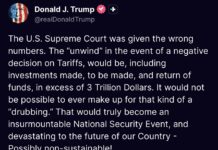
And the Supreme Court is poised to strip Trump of his unilateral tariff power, exposing the government to hundreds of thousands of lawsuits.
Then came Trump’s most revealing line of the week—delivered almost casually:
“I’d be comfortable moving back to New York City and living there with Mamdani as mayor.”
It sounded like a joke. It wasn’t.
It was the political equivalent of a man checking the exits.
Congress No Longer Fears Him
The bipartisan vote to unseal the Epstein files was more than a procedural action—it was a barometer. For years, Republicans treated Trump like a figure whose anger could cost them their seats. Now, a critical mass of them has decided that the greater risk lies in being tied to him as the political temperature rises.
The Epstein documents represent a political minefield. Trump knows this.
The people who once protected him also know this.
And yet they voted to proceed anyway.
That is not rebellion.
That is calculation.
And it is devastating for a president who rules through the performance of strength.
When Marjorie Taylor Greene Leaves, the Movement Is Fracturing
No one embodied Trumpist devotion more than Greene. She was the id of MAGA politics—loud, conspiratorial, and unwaveringly loyal.
So when she abruptly quit Trump’s team, citing the coming electoral “bloodbath,” it wasn’t just a personal break. It was a public signal that the once-unbreakable coalition of grievance is splintering.
Movements don’t collapse at the edges; they collapse at their core.
And Greene was the core.
The Crypto Meltdown Strikes at Trump’s New Center of Power
Since returning to the White House, Trump has used crypto not as policy but as infrastructure—a pathway for foreign investment, a private financial empire, and a symbolic currency of loyalty.
But crypto is a faith-based economy.
And faith is fragile.
As markets tumbled, so did the Trump family’s stake in World Liberty Financial.
The empire he spent the last two years constructing—built on tokens, stablecoins, and ties to foreign sovereign funds—lost its shine in a matter of hours.
The collapse wasn’t just financial; it was political.
When Trump’s wealth falls, his aura falls with it.
He is a politician who has always equated being rich with being right.
A shrinking portfolio is, in his worldview, a shrinking presence.
Trump Media’s Implosion Is a Psychological Blow
The DJT stock was never a business; it was a belief system.
A stock price held up by tribal identity rather than earnings.
A digital mirror of Trump’s political strength.
This week that mirror cracked.
The near-$5 billion evaporation of wealth struck at the heart of Trump’s mythology: the myth of the invincible dealmaker, the eternal winner, the man who can bend markets to his will by tweeting alone.
Markets have now delivered their verdict:
“Not anymore.”
A man who built a political movement around dominance cannot survive long when markets portray him as a loser.
The Supreme Court Is Preparing the Cruelest Cut
For Trump, unilateral tariff power has been both weapon and shield— a tool to punish enemies, reward allies, and reshape global trade at whim.
But the Supreme Court is now poised to rule that this authority exceeds the powers of the presidency.
If that happens, three consequences follow immediately:
- Trump’s economic authority collapses.
- His signature policy is declared unlawful.
- The federal government faces a deluge of lawsuits from businesses seeking refunds.
It is the kind of institutional humiliation Trump cannot tolerate:
a constitutional reminder that the presidency is not a monarchy.
And Then Trump Looked Toward New York
Amid all this political wreckage, Trump floated a line that said more than any press conference:
He would be “comfortable” moving back to New York—if Zohran Mamdani were mayor.
Mamdani is a progressive icon, the antithesis of Trumpism.
For Trump to speak of him with warmth is, in the language of politics, a profound shift.
This was not outreach.
It was reconnaissance.
Like any cornered politician, Trump is probing the future:
- Can he return to the city that prosecuted him?
- Can he find a soft landing where institutions have teeth?
- Can he negotiate, charm, or simply outlast his enemies?
A man preparing to consolidate power does not muse about retirement in New York.
A man preparing to escape does.
The Beginning of an Exit Strategy
The cumulative effect of this week is unmistakable:
Trump is losing the three pillars that sustained his power—
Fear. Money. Mythology.
Congress no longer fears him.
Markets no longer obey him.
Even his most loyal disciples are slipping away.
When a president begins hinting at where he might live next, it is not idle talk.
It is the earliest stage of psychological retreat.
Trump is not leaving office tomorrow.
But for the first time in years, he is speaking like a man imagining life after the presidency—
a man weighing what safety looks like, what freedom looks like, and what defeat feels like.
And America, watching this strange and revealing week unfold, must ask itself:
What happens when a president begins preparing for his own exile?