








































January 2, 2025
For years, Donald Trump’s Epstein Files defense has been insultingly simple.
“I barely knew him.”
“He stole my girls.”
“I kicked him out.”
It was always thin. Now it’s ashes.
The Wall Street Journal has dropped reporting that doesn’t just poke holes in Trump’s story—it documents an operational system inside Trump’s own business that sent young women directly into Jeffrey Epstein’s orbit. Not socially. Not accidentally. At work. At Trump’s club. Under Trump’s authority.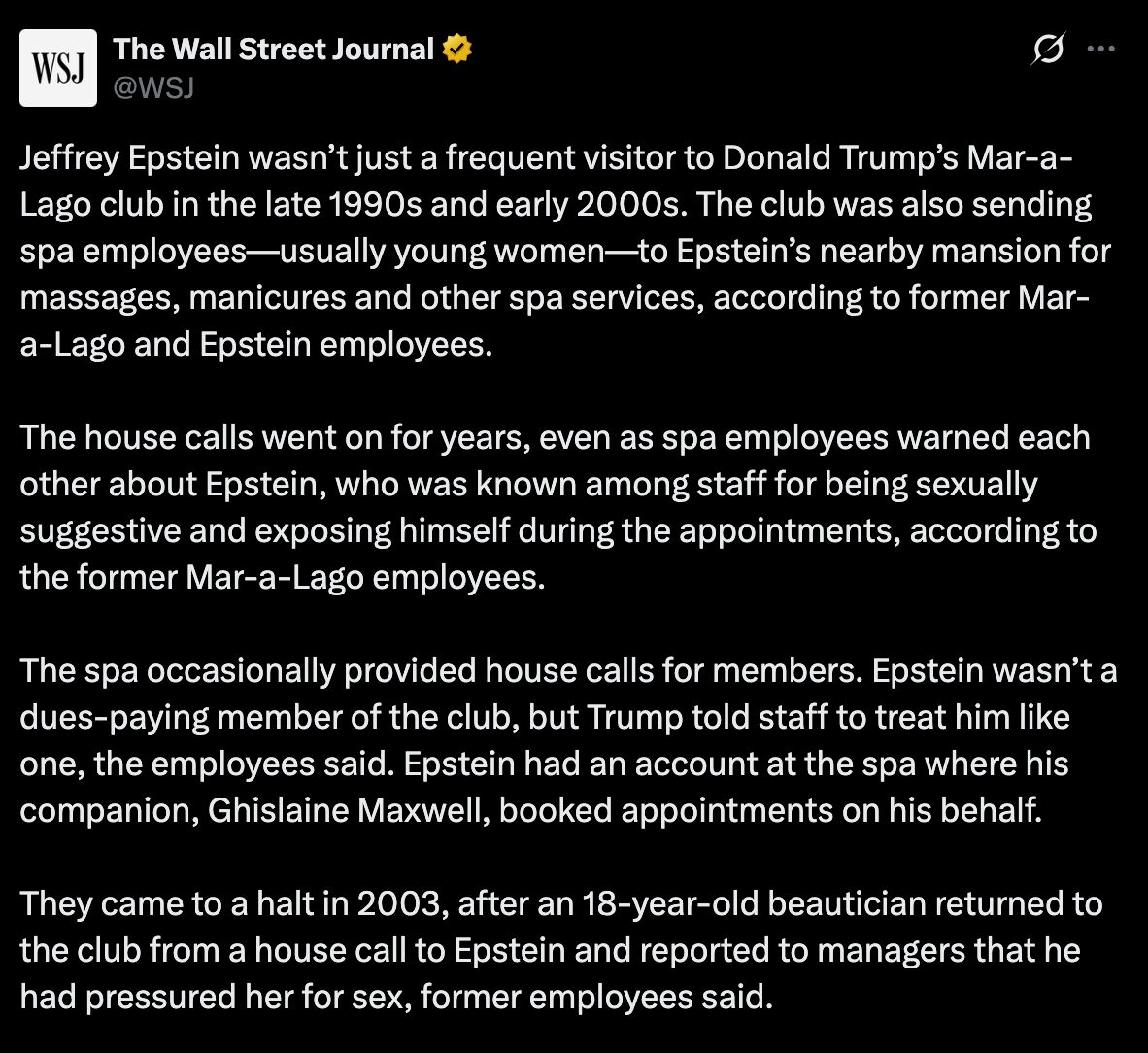
This isn’t about vibes. It’s about structure, direction, warnings ignored, and a crime that only stopped when it became inconvenient.
Call it what it is. The WSJ says they have proof that Trump trafficked women and young girls to Epstein and others out of Mar-A-Lago for years.
Shame on you if you needed more proof, btw.
Mar-a-Lago Wasn’t Just a Club. It Was a Workplace.
Trump wants you to picture Mar-a-Lago as a fancy backdrop—champagne, donors, gossip. But legally and practically, Mar-a-Lago was something else entirely: a privately controlled business employing young women, many of them early in their careers, under strict management.
One part of that business was the spa.
And according to former employees, the spa did more than pamper guests. It sent workers off-site for “house calls.” Massages. Manicures. “Other spa services.” This wasn’t rogue behavior. It was policy.
That matters. Because the destination wasn’t random.
It was Jeffrey Epstein’s mansion.
Epstein Wasn’t a Member—Except Trump Said He Was
Here’s the first crack in Trump’s long-running alibi.
Epstein wasn’t a dues-paying member of Mar-a-Lago. Yet staff say Trump personally ordered them to treat him like one. Epstein had a spa account. Appointments were booked on his behalf—often by Ghislaine Maxwell.
This went on for years.
During that time, spa employees say Epstein became known among staff for sexually assaulting these women and young girls. Over and over again. Exposing himself. Grapping women and young girls and pressuring them into sex or else.
And still, the house calls continued. Trump kept sending young girls and women. Epstein abused and trafficked hundreds more. Until Epstein stole Virginia Guiffre from Trump, according to Trump, then it stopped (according to Trump):
The Pipeline, Step by Step
Strip away the gold trim and this looks chillingly familiar:
-
Young women employed at a prestigious workplace
-
Sent by management to a powerful man’s private home
-
Warnings ignored when concerns emerge
-
No police involvement when lines are crossed
-
Action only taken when the risk reaches the boss directly
2003: The Moment Trump Can’t Run From
The system didn’t collapse because leadership suddenly grew a conscience. It collapsed because someone spoke up loudly enough to reach Trump himself.
An 18-year-old beautician returned from a house call to Epstein’s mansion and reported that Epstein pressured her for sex.
A manager did the right thing—for once.
They sent Trump a fax detailing the allegation and urging that Epstein be banned. According to former employees, Trump read it, called it “a good letter,” and ordered Epstein removed.
Trump’s defenders treat this as exculpatory. It isn’t.
It proves the opposite.
It proves:
-
Trump had direct authority
-
Trump was alerted only after escalation
-
Trump tolerated the system until it became a liability
And here’s the part that should haunt every newsroom in America:
The incident was never reported to police.
Not to the Palm Beach Police Department.
Not to any outside authority.
HR was told. Management was told. Trump was told.
Law enforcement never was.
Trump’s Story vs. Reality
Trump later claimed Epstein “stole my girls.”
That phrase alone should have ended his political career.
But the WSJ reporting now exposes it as something worse than misogyny—it’s a lie designed to erase responsibility.
These women weren’t “stolen.”
They were sent.
By Trump’s business.
Under Trump’s management.
For years.
Epstein didn’t infiltrate Mar-a-Lago. He was accommodated.
Trump didn’t “barely know” Epstein. He gave him access, status, and a pipeline of young workers—until someone finally forced his hand.
Where Virginia Giuffre Was Always Right
For years, Virginia Giuffre has said Mar-a-Lago was part of Epstein’s recruitment ecosystem. She was dismissed, attacked, litigated into silence, and accused of exaggeration.
Now the mechanism she described is sitting in black-and-white reporting from former employees who worked inside Trump’s club.
Work became trust.
Trust became access.
Access became abuse.
This isn’t corroboration by rumor. It’s corroboration by process.
Let’s Stop Dancing Around the Word
When a business:
-
Directs young workers to a known predator’s home
-
Ignores internal warnings about sexual misconduct
-
Fails to contact police after allegations of coercion
-
Continues operations until the boss is personally inconvenienced
That meets the definition of sex trafficking.
Not in the Hollywood sense. In the legal, structural sense.
People were moved.
For labor.
Under authority.
Into harm.
Calling it anything else is cowardice.
Why This Matters Now
Trump’s entire Epstein defense strategy has depended on distance. Distance from knowledge. Distance from action. Distance from responsibility.
The WSJ just erased that distance.
This wasn’t a party photo.
This wasn’t a friendship.
This wasn’t “New York in the ’90s.”
This was Trump’s workplace, sending Trump’s employees, into Epstein’s house, until an 18-year-old finally said enough.
And even then, the system didn’t trigger justice. It triggered damage control.
The Questions That Refuse to Go Away
How many women were sent?
How many warnings were ignored?
Who else knew?
And why was the police never called?
Trump has spent years demanding investigations into everyone but himself.
Here’s one he still hasn’t answered.