







































Caesar Rodney, whose statue was placed in storage amid racial injustice protests in 2020, will be honored in Washington this summer.
A founding father and slave owner whose statue in Delaware was removed in 2020 amid calls for racial reckoning will be given a position in honor in Washington by the Trump administration as part of celebrations of the nation’s 250th birthday, internal Interior Department documents show.
On July 2, 1776, Caesar Rodney raced from Dover, Del., to Philadelphia on horseback to cast his state’s decisive vote in favor of the Declaration of Independence. It would be formally adopted by the Continental Congress two days later, July 4, on what is now celebrated as Independence Day.
Though somewhat obscure as founding fathers go, Mr. Rodney caught President Trump’s attention during his first term. (A conservative think tank in Delaware that, like Mr. Trump, opposes offshore wind farms and advocates for cutting taxes and regulation, is named after Caesar Rodney.) At the time, Mr. Trump criticized the city of Wilmington for removing Mr. Rodney’s statue, calling it part of a “radical purge of America’s founding generation.” Historians said Mr. Rodney enslaved as many as 200 men and women.
Now the Interior Department plans to take Mr. Rodney’s statue from a Delaware storage facility and temporarily place it in Washington’s Freedom Plaza as part of America’s semiquincentennial, according to a Feb. 3 National Park Service memo reviewed by The New York Times.
Charlotte Taylor, a spokeswoman for the Interior Department, confirmed the plan to feature Mr. Rodney in Washington. “As the nation approaches the 250th anniversary of American independence, the Department is working with partners to highlight individuals associated with the founding era,” she said in a statement.
Supporters of the decision said Mr. Rodney’s pivotal role in American history deserves to be recognized. Critics called it the latest in a long string of Trump administration insults to Black Americans.
In January, the administration removed exhibits on slavery from Independence National Historical Park in Philadelphia. The Interior Department said it was complying with Mr. Trump’s order to “review interpretive materials to ensure accuracy, honesty, and alignment with shared national values.” A federal judge later ordered that the exhibit be restored, but litigation is ongoing.
Mr. Trump has complained that the Smithsonian Institution focused too much on “how bad slavery was.” His administration has embraced Confederate history in the military and in public spaces, and last year it restored a memorial in Washington, D.C., to a Confederate general, Albert Pike.
“It’s part of this larger landscape of how the Trump administration is manipulating history to advance their own particular ideology,” said Adam Rothman, director of Georgetown University’s Center for the Study of Slavery and Its Legacies. “It’s a whitewashed patriotic history.”


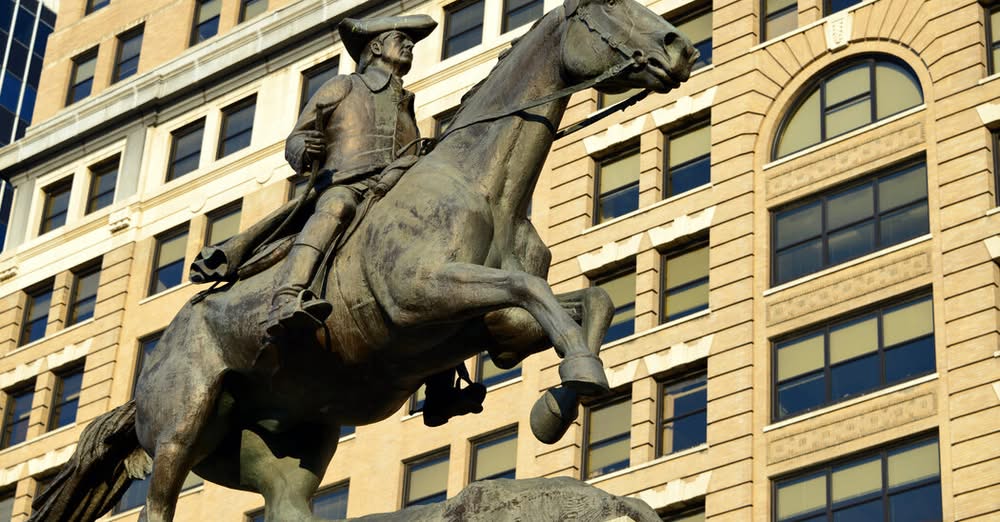
Mr. Rodney is best known for galloping from Dover to Philadelphia to cast the deciding vote in favor of the Declaration of Independence on July 2, 1776.Corbis, via Getty Images; Jan Zwolinski/Zoonar, via Alamy
A Dramatic Ride for Independence
Mr. Rodney was born in 1728 on his family’s plantation near Dover, Del. He held multiple public offices, including as a justice of the peace, a member of the Colonial State Assembly and a delegate to the Stamp Act Congress. From 1774 through 1776, Mr. Rodney served as a member of the Continental Congress.
He was at home in Delaware during the first two days in July 1776, when a resolution for a declaration of independence was being debated in Philadelphia. Delaware’s other two delegates were split, with Thomas McKean for it and George Read against.
Mr. McKean dispatched an urgent message to Mr. Rodney to come cast his vote. Historians said within minutes of receiving the letter, Mr. Rodney jumped in the saddle and rode through the night in thunder and rain (though some part of the journey may also have occurred by carriage) to reach the Continental Congress in Philadelphia. He arrived just in time to swing his colony in favor of independence and secure the declaration.
“Ceasar Rodney was really a remarkable character in Delaware history,” said Dick Carter, chairman of the state’s heritage commission. And, he added, “Rodney was also a slaveholder, which is the root of the controversy.”
When Mr. Rodney was 17, his father died, leaving him the heir to the family plantation, an 849-acre wheat and barley farm, and as many as 200 enslaved people. The names of those men and women are not known, Mr. Carter said.
Yet there are also some indications that Mr. Rodney was personally opposed to slavery.
In 1767, when he was speaker of the colonial assembly, Mr. Rodney introduced a bill that would prohibit the importation of slaves into Delaware. The measure did not pass. He also directed in his will that all his enslaved people should be freed when he died or shortly thereafter.
A bronze statue of Mr. Rodney on a galloping horse stood in downtown Wilmington from 1923 to 2020, when it was removed from public display — along with a statue of Christopher Columbus — in the wake of nationwide racial justice protests after the murder of George Floyd in police custody in Minneapolis.
Mr. Trump, then in his first term, denounced what he called a “twisted web of lies” being taught in schools, and vowed to counter classroom teachings that “America is a wicked and racist nation.”
Locked in a tight election battle with his Democratic opponent, Joseph R. Biden, the former vice president and senator from Delaware, Mr. Trump denounced Mr. Biden for not speaking out about the statue. “Joe Biden said nothing as to his home state’s history and the fact that it was dismantled and dismembered. And a Founding Father’s statue was removed,” Mr. Trump said in September 2020.
He announced he would place a statue of Mr. Rodney in what he called the National Garden of American Heroes park.
That park did not materialize during Mr. Trump’s first term but has since been revived in connection with this summer’s celebrations.
According to the National Park Service memo, Mr. Rodney’s statue will be taken out of storage in Delaware and displayed temporarily in Freedom Plaza on Pennsylvania Avenue in Washington. The public plaza was designed in 1980 to honor Martin Luther King Jr.
“Trump wants to erase the stain of slavery from history,” said Kellie Carter Jackson, chair of the Department of Africana Studies at Wellesley College. But, she said, “No matter how hard you scrub, you are not going to erase that stain. It’s there in blood.”
Dr. Carter Jackson said Mr. Trump has been obsessed with the removal of statues as well as discussions of racial reckoning in America.
“Trump has consistently operated with a massive racial chip on his shoulder,” she said. “He sees himself as a victim, even oppressed, as absurd as that sounds. His attempt to bring back the statue is his way of almost sticking it to who he thinks ‘woke people’ are.”
‘You Can Have Him, D.C.’
The fate of Mr. Rodney’s statue has also been a deep source of tension in his home state.
Eric L. Buckson, a Republican state senator who has called for the statue to be displayed again, said America’s 250th birthday is an appropriate time and place to honor Mr. Rodney.
“He’s going to be in Washington, D.C., because he changed the course of the country,” Mr. Buckson said, adding, “It wouldn’t have been July 4 without Caesar Rodney.”
After being displayed in Washington, Mr. Rodney’s statue should be restored in Delaware again, preferably in the founder’s home of Kent County, Mr. Buckson said. But he said it should be done in a way that both notes Mr. Rodney’s accomplishments and his role as a slave owner.
Shané N. Darby, a councilwoman from Wilmington, called glorifying Mr. Rodney “a slap in the face of Black and brown people of this city.” She said she understood displaying his statue as part of America’s birthday celebration, but said it should remain Washington afterward.
“You can have him, D.C.,” Ms. Darby said. “I do not think he needs to have a statue in his honor at all. If anything, I believe we should put up the names of the people who he enslaved.”
Yet many historians said that while they oppose the Trump administration’s efforts to erase the history of oppression in the United States, they don’t want to see Mr. Rodney’s statue removed permanently from public viewing.
“We can’t deny their role in the founding of the country, and we can’t deny that they are slaveholders,” Dr. Carter Jackson said. “You tell a fuller story about the dirty business of slavery, and then you give people the ability to discern for themselves what they want to think about a particular person,” she said.
Lisa Friedman is a Times reporter who writes about how governments are addressing climate change and the effects of those policies on communities.
Get four individual logins in one account.
Add three people to your subscription.
Only $1.25 more per week
Billed as $30 every 4 weeks.