































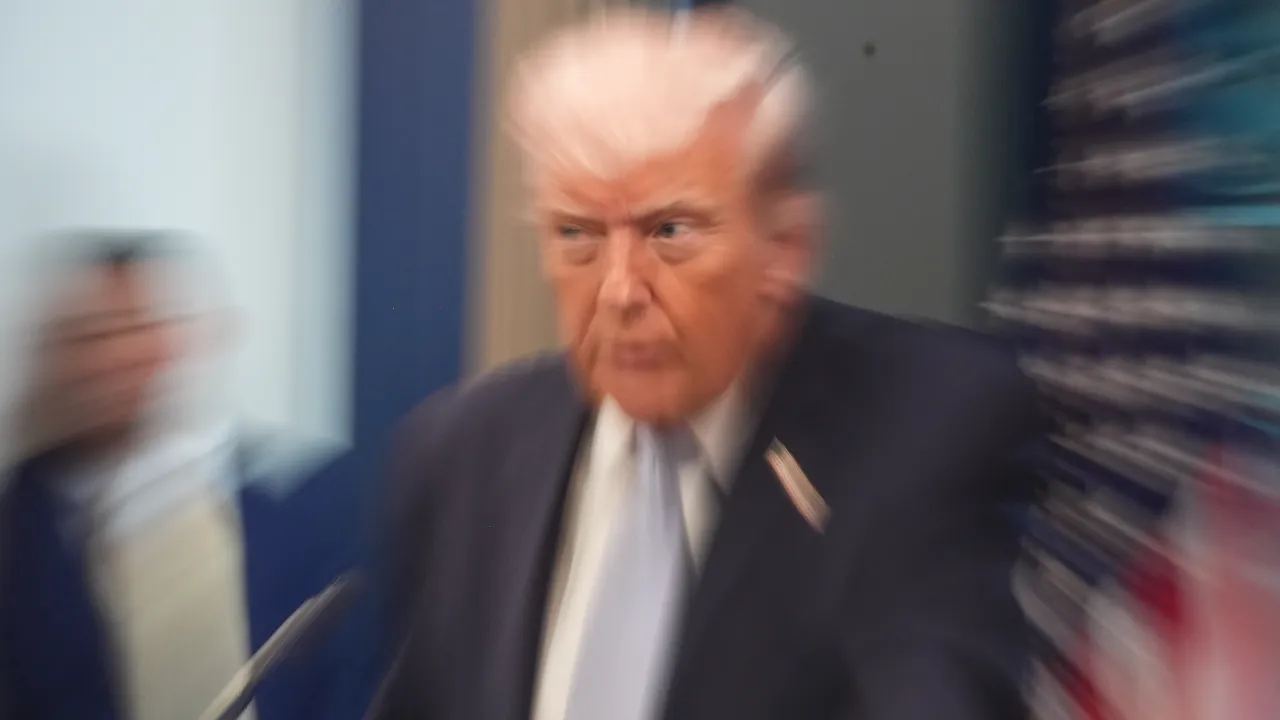
On Easter morning, President Trump took to Truth Social and issued a statement that would have been unthinkable from any other modern American president. Just reading it was visceral: “Tuesday will be Power Plant Day, and Bridge Day, all wrapped up in one, in Iran,” he wrote a little after 8 a.m. “Open the F–kin’ Strait, you crazy bastards, or you’ll be living in Hell — JUST WATCH. Praise be to Allah.”
Strip away the shock value for a moment and consider what this represents in practical terms. This is not a stray remark at a rally. Nor was it a misstatement quickly corrected by staff. This is a public declaration, directed at a geopolitical adversary, during an active and escalating international crisis.
And it also raises a question that Washington has spent years trying to avoid: What happens when the risk is not external, but presidential?
The 25th Amendment to the Constitution was not written for partisan convenience. It was designed for moments when the continuity and stability of executive decision-making come into question. Its purpose is not to punish a president but to protect the country.
For decades, the 25th Amendment has been treated as politically radioactive. That made sense when the threshold was hypothetical or remote. But it makes far less sense when real concerns are playing out in real time, in full public view, during a potential military escalation in one of the most volatile regions in the world.
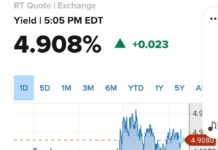
This is not about ideology. It is not about whether one supports or opposes the administration’s broader policies. It is about capacity. The presidency demands a level of judgment that is measured, deliberate and anchored in an understanding of consequence. Words spoken — or posted — by a president are not just rhetoric. They are signals. Markets react to them. Allies interpret them. Adversaries test their elasticity.
When those signals become erratic, inflammatory or untethered from strategic coherence, the risk is not abstract. It is immediate.
We have already seen how quickly miscalculation can spiral in the context of Iran. The Strait of Hormuz is not a metaphor. It is one of the most critical chokepoints in the global energy supply chain. Any suggestion of force, blockade or retaliation carries real-world implications for oil markets, military positioning and civilian stability across multiple continents.
Against that backdrop, language that reads more like provocation than policy is not just inappropriate. It is destabilizing.
There is also a deeper institutional issue at play. For years, both parties have quietly expanded the power of the executive branch. In moments of crisis, Congress tends to defer. Agencies align. The system consolidates around the presidency.
That model only works if the person at the center of it is capable of exercising restraint. If that assumption begins to break down, the system does not self-correct. It amplifies.
That is precisely why the 25th Amendment exists. It is a constitutional release valve for moments when the normal checks and balances are not enough to address a breakdown in executive function.
To invoke it would be serious. It should be. But seriousness cannot be an excuse for inaction. What would be far more dangerous is continuing to pretend that this is normal.
There is a tendency in Washington to normalize what it cannot easily confront. To reinterpret behavior as strategy. To wait for a clearer line that justifies action. But constitutional safeguards are not meant to be used only when collapse is obvious and irreversible. They are meant to prevent reaching that point.
A bipartisan conversation about the 25th Amendment is not a declaration. It is a starting point. It is an acknowledgment that the threshold for concern has been crossed, and that the mechanisms designed to address that concern should at least be evaluated in good faith.
That conversation will be uncomfortable. It will be politically charged. It will invite accusations of opportunism from both sides.
It should happen anyway, because the alternative is to accept that no matter how unpredictable, inflammatory or potentially destabilizing presidential conduct becomes, the system will simply absorb it.
That is not what the Constitution contemplates, and it is not a risk the country can afford to take.
Aron Solomon is chief strategy officer for AMPLIFY and has taught entrepreneurship at McGill University and the University of Pennsylvania.