











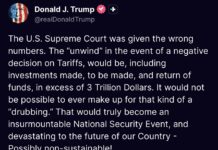


















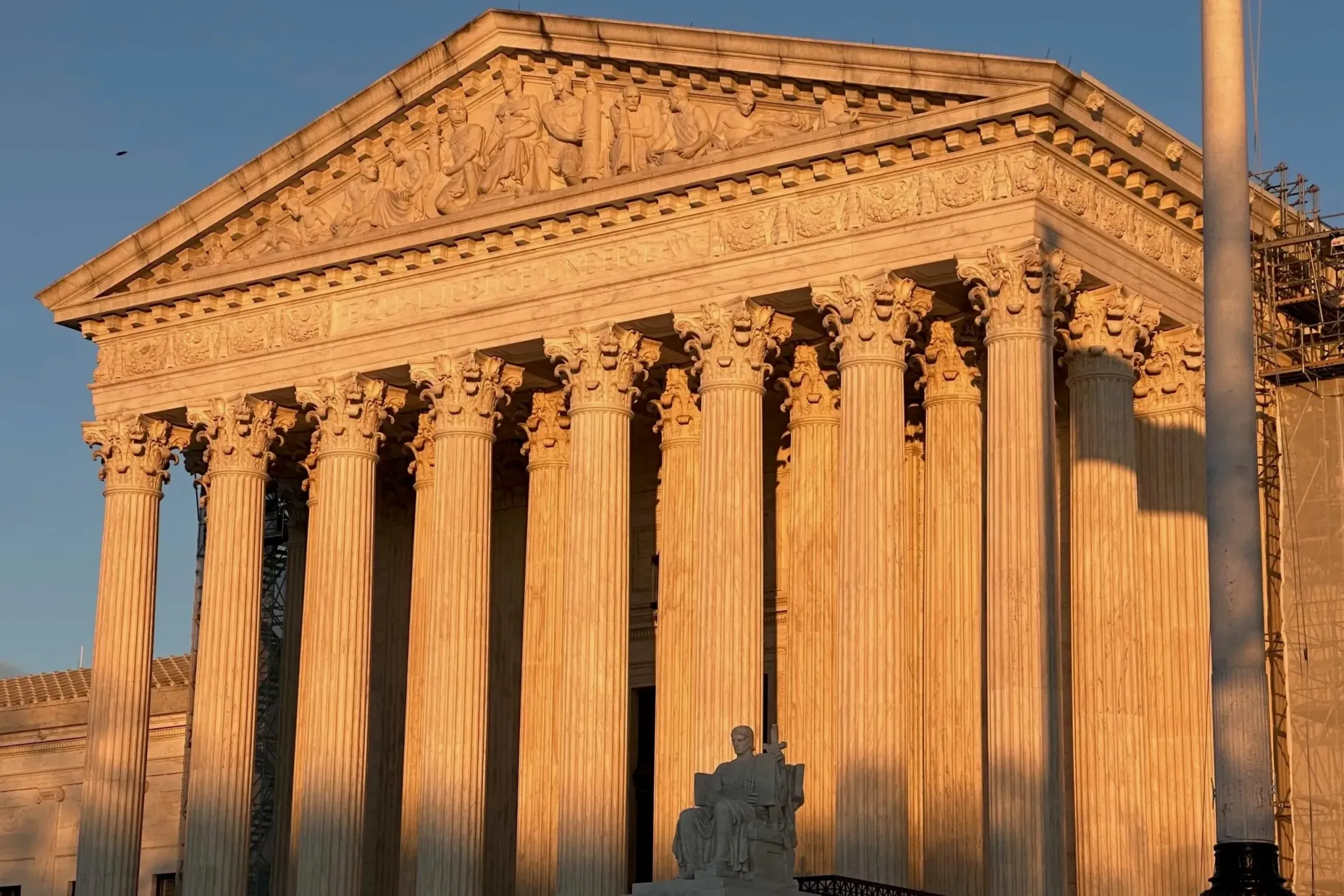
In a major ruling on presidential power, the Supreme Court on Friday struck downthe sweeping tariffs that President Donald Trump imposed in a series of executive orders. By a vote of 6-3, the justices ruled that the tariffs exceed the powers given to the president by Congress under a 1977 law providing him the authority to regulate commerce during national emergencies created by foreign threats.
The court did not weigh in, however, on whether or how the federal government should provide refunds to the importers who have paid the tariffs, estimated in 2025 at more than $200 billion.
The law at the center of the case is the International Emergency Economic Powers Act, known as IEEPA, which authorizes the president to use the law “to deal with any unusual and extraordinary threat, which has its source in whole or substantial part outside the United States, to the national security, foreign policy, or economy of the United States, if the president declares a national emergency with respect to such threat.” A separate provision of the law provides that when there is a national emergency, the president may “regulate … importation or exportation” of “property in which any foreign country or a national thereof has any interest.”
The dispute at the center of Friday’s opinion began last year, when Trump issued a series of executive orders imposing the tariffs. Lawsuits filed by small businesses and a group of states, all of which say that they are affected by the increased tariffs, were filed in the lower courts, which agreed with the challengers that IEEPA did not authorize Trump’s tariffs. But those rulings were put on hold, allowing the government to continue to collect the tariffs while the Supreme Court proceedings moved forward.
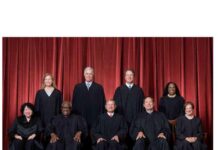
In a splintered decision on Friday, the Supreme Court agreed with the challengers that IEEPA did not give Trump the power to impose the tariffs. “Based on two words separated by 16 others in … IEEPA—‘regulate’ and ‘importation’—the President asserts the independent power to impose tariffs on imports from any country, of any product, at any rate, for any amount of time,” Chief Justice John Roberts wrote. “Those words,” he continued, “cannot bear such weight.” “IEEPA,” Roberts added, “contains no reference to tariffs or duties.” Moreover, “until now no President has read IEEPA to confer such power.”
In a part of the opinion joined by Justice Neil Gorsuch and Justice Amy Coney Barrett, Roberts said that Trump’s reliance on IEEPA to impose the tariffs violated the “major questions” doctrine – the idea that if Congress wants to delegate the power to make decisions of vast economic or political significance, it must do so clearly. “When Congress has delegated its tariff powers,” Roberts said, “it has done so in explicit terms, and subject to strict limits,” a test that Trump’s tariffs failed here.
The court’s three Democratic appointees – Justices Sonia Sotomayor, Elena Kagan, and Ketanji Brown Jackson – joined another part of the Roberts opinion, holding that Trump’s tariffs were also not supported by the text of IEEPA. “The U.S. Code,” Roberts noted, “is replete with statutes granting the Executive the authority to ‘regulate’ someone or something. Yet the Government cannot identify any statute in which the power to regulate includes the power to tax.”
Justice Brett Kavanaugh wrote the main dissent, which was joined by Justices Clarence Thomas and Samuel Alito. In his view, Trump had the authority under IEEPA to impose the tariffs because they “are a traditional and common tool to regulate importation.” Moreover, he suggested, although “I firmly disagree with the Court’s holding today, the decision might not substantially constrain a President’s ability to order tariffs going forward … because numerous other federal statutes authorize the President to impose tariffs and might justify most (if not all) of the tariffs at issue in this case.”
Kavanaugh also warned that “[i]n the meantime, however, the interim effects of the Court’s decision could be substantial. The United States may be required to refund billions of dollars to importers who paid the IEEPA tariffs, even though some importers may have already passed on costs to consumers or others.”
Posted in Court News, Featured, Merits Cases
Cases: Learning Resources, Inc. v. Trump (Tariffs), Trump v. V.O.S. Selections
Recommended Citation: Amy Howe, Supreme Court strikes down tariffs,SCOTUSblog (Feb. 20, 2026, 11:00 AM), https://www.scotusblog.com/2026/02/supreme-court-strikes-down-tariffs/