







































By James Pearson and Ryan McNeill
The Shajareh Tayyebeh School website posted colorful drawings created by the students and was filled with photos of children. School website/Wayback Machine. Photo collage by John Emerson/REUTERS
The Shajareh Tayyebeh School was adjacent to an Iranian military compound and was among at least seven buildings struck February 28. Its online presence included a local business listing and a website that showed girls at work and play. Iranian officials have said students made up most of the 175 people killed that day in Minab.
LONDON – An Iranian girls school that took a direct hit on the first day of the war had a yearslong online presence, including dozens of photos of the children and their activities, before it was bombed along with at least six other buildings in an adjacent military compound, a Reuters investigation found.
Separated from the base by a wall painted with bright murals, the Shajareh Tayyebeh School was the northernmost building hit on February 28. The building was destroyed during the barrage, and 150 students were killed, according to Iran’s ambassador to the U.N. in Geneva, Ali Bahreini. Reuters has not independently confirmed the death toll, which the Iranian Red Crescent said reached 175.
The colored walls visible from satellite imagery as early as 2018 can be seen in a version of the school’s website archived in 2025, whose photos showed girls dressed in identical pink and white in class and at play. The school was also tagged in a local business listing, Reuters found. And multiple satellite images from the months leading up to the strike provide other indications it was a school, including playground markings.
The cluster of buildings appeared to have been struck by a series of munitions, including at least one American Tomahawk cruise missile, according to an analysis of satellite imagery data, photos and video of the strikes and their aftermath.
Video of the moment of impact by the Tomahawk on the buildings nearby showed a plume of smoke rising in the background. Satellite images from after the attack showed signs of at least seven distinct explosions along a roughly 325-meter axis, including the destroyed school, a rooftop punctured by a gaping hole, and a flattened building.
A satellite image, annotated by Reuters, shows the Shajareh Tayyebeh girls’ school in Minab and other structures damaged after being struck on the war’s first day. 2026 Planet Labs PBC/Handout via REUTERS
U.S. President Donald Trump said Monday that Iran might have Tomahawks, although he did not explain how, and no U.S. officials have offered evidence of that claim.
The Pentagon said the strike is under investigation but declined to comment on the school’s online presence, the satellite imagery or on the decision to target the Minab compound.
Two sources, both speaking on condition of anonymity, told Reuters outdated targeting data may have been to blame, which was first reported by the New York Times.
Mark Cancian, a retired U.S. Marine officer and defense expert with the Center for Strategic and International Studies think tank, said the U.S. Central Command would have had a longstanding list of potential targets in case of conflict with Iran. “The lesson learned here would be to review the target lists periodically and more closely,” he said.
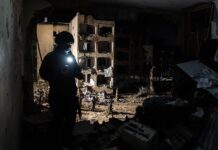
People search through the debris of the girls school in Minab struck on February 28, the first day of the war. Abbas Zakeri/Mehr News/WANA (West Asia News Agency) via REUTERS
The school and at least six buildings in the adjacent Islamic Revolutionary Guard Corps compound were the only places struck within 5 kilometers between February 28 and March 2, Reuters found. This suggests they were specifically targeted, rather than struck as part of a broad bombing campaign on the southern city.
Located near the Strait of Hormuz and surrounded by farm fields, Minab is home to one of the IRGC’s largest missile bases, according to state media.
The Reuters analysis included changes detected between those dates by satellites, which even over a large area can measure shifts from upheavals such as destroyed buildings, fire, flooding or landslides.
In the days after the strike, another place in Minab showed major disturbance in the analysis: the town cemetery. There, on March 2, the dead children were buried, creating row after row of 20 tidy rectangular holes in the earth.
Graves were prepared for the victims in Minab on March 2. Iranian Foreign Media Department/WANA (West Asia News Agency)/Handout via REUTERS
THE SCHOOL
Some of the schools in that network, including the Shajareh Tayyebeh girls school and its equivalent boys school in Minab, listed their addresses as being in or adjacent to IRGC-controlled locations, according to the archived website.
The boys school seems to share the address and be located on the side of the building that did not collapse. A comparison of post-strike images with archived photos of boys studying appears to show debris scattered on desks where students had once studied.
Satellite imagery from mid-2015 shows the building was walled off from the rest of the base and appears to have operated as a school since at least 2018, when the painted murals are first visible on its outer walls.
A November 26, 2015, satellite image, annotated by Reuters, shows the Shajareh Tayyebeh girls’ school in Minab, Hormozgan Province, Iran. 2026 Airbus DS/Handout via REUTERS
THE STRIKE
Before impact, smoke from what appears to be a previous attack on the compound is already visible in the video. Reuters verified the visual as taken on February 28 from videos of the aftermath and satellite imagery of intact buildings taken on the morning of the strike.
Reuters shared the video of the attack with five munitions experts. Four of the experts said the missile was likely a Tomahawk; one thought it was a glide bomb.
Joost Oliemans, a Netherlands-based conflict analyst who specializes in military equipment, concluded the compound was hit by a U.S. Tomahawk, saying that while a few countries had similar missiles, neither Israel nor Iran were among them. Joseph Dempsey, a military analyst with London’s International Institute for Strategic Studies, also identified it as a type of Tomahawk, although he did not rule out the possibility of a previously unknown missile.
In a March 4 press conference at the Pentagon, the U.S. military shared a map of locations it had struck in Iran. The map did not list Minab by name, but one of the strikes was marked with a red diamond where the city is located.
A photo of a map shared by the U.S. military in a March 4 press conference at the Pentagon. The location of Minab was added by Reuters. REUTERS/Idrees Ali
Reuters was unable to independently confirm if the missile fragments were found at the site of the school strike or whether the base connected to the school was still being used by the IRGC when the compound came under repeated strikes on February 28. But at the school there was activity as recently as December 2025. Satellite imagery showed what appeared to be people gathered in the schoolyard on a cloudless day.
The school motto, as posted on its website: “Today I learn; tomorrow we build.”
A satellite image, annotated by Reuters, shows the Shajareh Tayyebeh girls’ school December 1, 2025, nearly three months before it was struck. 2026 Vantor/Handout via REUTERS
Reporting by James Pearson and Ryan McNeill in London. Additional reporting by Parisa Hafezi, Edward James Carron, Stephanie Burnett and Idrees Ali. Design by John Emerson. Edited by Sarah Cahlan and Lori Hinnant.
London-based investigative journalist specialising in solving complex questions by combining open-source intelligence (OSINT) with traditional reporting techniques. Previously served as Reuters European Cybersecurity Correspondent, Vietnam Bureau Chief, and Korea Correspondent, reporting from North & South Korea, Vietnam, Laos, Cambodia, and the Sino–North Korean borderlands. My book, North Korea Confidential, came out in 2015.